Skip to main content
Analytical Chemistry
My Course
Learn
Exam Prep
AI Tutor
Study Guides
Flashcards
Explore
Try the app
My Course
Learn
Exam Prep
AI Tutor
Study Guides
Flashcards
Explore
Try the app
Back
The pH Scale definitions
You can tap to flip the card.
pH Scale
You can tap to flip the card.
👆
pH Scale
A numerical range, typically 0 to 14, used to express the acidity or basicity of a solution under standard conditions.
Track progress
Control buttons has been changed to "navigation" mode.
1/14
Related flashcards
Related practice
Recommended videos
The pH Scale quiz
The pH Scale
15 Terms
The pH Scale
6. Chemical Equilibrium
5 problems
Topic
Acid Strength
6. Chemical Equilibrium
5 problems
Topic
6. Chemical Equilibrium - Part 1 of 3
4 topics
12 problems
Chapter
6. Chemical Equilibrium - Part 2 of 3
4 topics
12 problems
Chapter
6. Chemical Equilibrium - Part 3 of 3
2 topics
6 problems
Chapter
Guided course
04:25
pH and pOH Calculations 1
593
views
Guided course
05:18
pH and pOH
461
views
1
rank
Guided course
02:55
pH and pOH
318
views
2
rank
Terms in this set (14)
Hide definitions
pH Scale
A numerical range, typically 0 to 14, used to express the acidity or basicity of a solution under standard conditions.
Hydrogen Ion Concentration
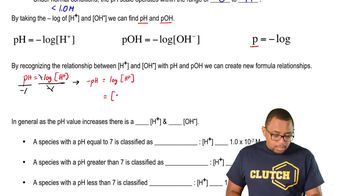
A measure, in moles per liter, of H+ present in a solution, directly influencing its acidity.
Hydroxide Ion Concentration
A measure, in moles per liter, of OH- present in a solution, directly influencing its basicity.
pOH
A logarithmic value representing the concentration of hydroxide ions, calculated as the negative log of [OH-].
Negative Logarithm
A mathematical operation used to convert small ion concentrations into manageable numbers for pH and pOH calculations.
Neutral Solution
A state where H+ and OH- concentrations are equal, each at 1.0 x 10^-7 M, resulting in a pH of 7.
Basic Solution
A classification for solutions with pH above 7, where OH- concentration exceeds H+ concentration.
Acidic Solution
A classification for solutions with pH below 7, where H+ concentration exceeds OH- concentration.
Ion Product Constant for Water
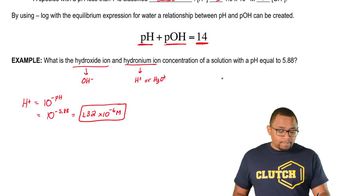
A fixed value, 1.0 x 10^-14 at 25°C, representing the product of H+ and OH- concentrations in water.
Antilogarithm
A mathematical process used to reverse a logarithm, allowing calculation of ion concentrations from pH or pOH.
Molarity
A unit expressing the number of moles of solute per liter of solution, used for ion concentrations.
Relationship between pH and pOH
A direct connection where their sum equals 14, enabling calculation of one value if the other is known.
Acidity
A property determined by the relative abundance of H+ ions in a solution, reflected by lower pH values.
Basicity
A property determined by the relative abundance of OH- ions in a solution, reflected by higher pH values.
 BackBack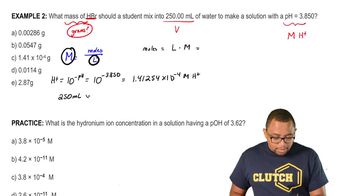
 04:25
04:25