Skip to main content
Analytical Chemistry
My Course
Learn
Exam Prep
AI Tutor
Study Guides
Flashcards
Explore
Try the app
My Course
Learn
Exam Prep
AI Tutor
Study Guides
Flashcards
Explore
Try the app
Back
Types of Errors quiz
You can tap to flip the card.
What is experimental error in the context of analytical chemistry?
You can tap to flip the card.
👆
What is experimental error in the context of analytical chemistry?
Experimental error refers to the uncertainty present in all measurements and calculations.
Track progress
Control buttons has been changed to "navigation" mode.
1/15
Related flashcards
Related practice
Recommended videos
Types of Errors definitions
Types of Errors
14 Terms
Types of Errors
3. Experimental Error
5 problems
Topic
Uncertainty
3. Experimental Error
5 problems
Topic
3. Experimental Error - Part 1 of 2
4 topics
12 problems
Chapter
3. Experimental Error - Part 2 of 2
3 topics
9 problems
Chapter
Guided course
01:56
Types of Errors
469
views
4
rank
Guided course
02:35
Types of Error
624
views
5
rank
Guided course
04:04
Types of Errors
462
views
7
rank
Terms in this set (15)
Hide definitions
What is experimental error in the context of analytical chemistry?
Experimental error refers to the uncertainty present in all measurements and calculations.
What is another name for indeterminate error?
Indeterminate error is also called random error.
What causes indeterminate (random) error in experiments?
Indeterminate error arises from uncontrollable variables in an experiment.
Are random errors reproducible or not?
Random errors are not reproducible.
Can indeterminate errors be corrected?
Indeterminate errors cannot be corrected.
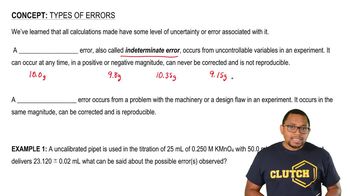
Give an example of random error in weighing.
If a 10-gram weight is measured as 9.8 grams, 10.35 grams, or 9.15 grams in different trials, this is random error.
What is another name for determinant error?
Determinant error is also called systematic error.
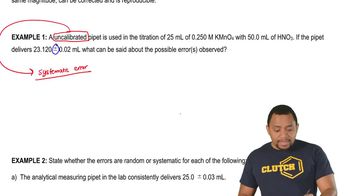
What typically causes systematic error?
Systematic error is usually caused by problems with machinery or flaws in experimental design.
Are systematic errors consistent in magnitude and direction?
Yes, systematic errors are consistent in both magnitude and direction.
Can systematic errors be corrected?
Yes, systematic errors can be identified and corrected.
Are systematic errors reproducible?
Yes, systematic errors are reproducible.
Give an example of systematic error in weighing.
If a 10-gram weight is always measured as 10.05 grams, this is a systematic error.
Why is it important to distinguish between random and systematic errors?
Understanding the difference helps ensure accurate measurements and allows for correction of systematic errors.
How do random errors affect measurement values?
Random errors cause measurement values to fluctuate unpredictably above or below the true value.
How do systematic errors affect measurement values?
Systematic errors cause all measurements to be consistently too high or too low by the same amount.
 BackBack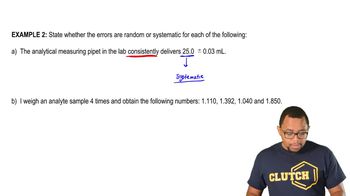
 01:56
01:56