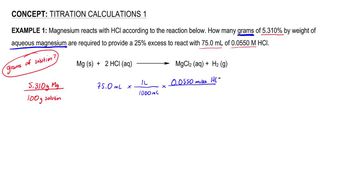
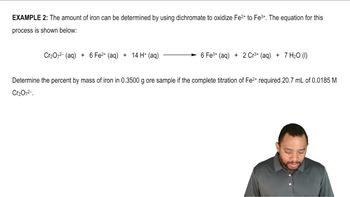
What is the main purpose of a titration in analytical chemistry?
The main purpose is to determine the amount of a substance in a sample by using a stoichiometric reaction.
What does gravimetric analysis help determine in a chemical reaction?
Gravimetric analysis helps determine the amount of product that can be isolated from a chemical reaction.
What is stoichiometry used for in titrations?
Stoichiometry is used to calculate the isolated amount of a substance based on a balanced chemical equation.
What is a stoichiometric chart and why is it important?
A stoichiometric chart is a tool that helps organize given and unknown quantities in a balanced chemical reaction, essential for solving titration problems.
How do you convert grams to moles in stoichiometric calculations?
You convert grams to moles by dividing the mass by the molecular weight of the compound.
What constant is used to convert between particles and moles?
Avogadro's number, 6.022 x 10^23, is used to convert between particles (atoms, ions, molecules, formula units) and moles.
When is the term 'atoms' used in stoichiometric calculations?
The term 'atoms' is used for neutral single elements, such as an oxygen atom (O).
What is the difference between molecules and formula units?
Molecules refer to covalent compounds (nonmetals bonded together), while formula units refer to ionic compounds (positive and negative ions bonded).
What is the significance of coefficients in a balanced chemical equation during titrations?
Coefficients indicate the mole ratios needed for mole-to-mole comparisons in stoichiometric calculations.
What is meant by 'the jump' in stoichiometric charts?
'The jump' refers to moving from the given information to the unknown quantity, typically requiring a mole-to-mole comparison.
Why is a balanced chemical equation necessary for titration calculations?
A balanced equation is necessary to ensure correct mole ratios are used when relating reactants and products.
What types of units might you be asked to find for an unknown in a titration problem?
You might be asked to find the unknown in moles, atoms, ions, molecules, formula units, or grams.
How do you convert from atoms, ions, molecules, or formula units to moles?
You divide the number of particles by Avogadro's number to get moles.
What is the first step when using a stoichiometric chart for titration calculations?
The first step is to identify the given information and convert it to moles if necessary.
Why is mastering the stoichiometric chart important for titrations?
Mastering the chart is essential for accurately solving titration and stoichiometric problems in analytical chemistry.
 Back
Back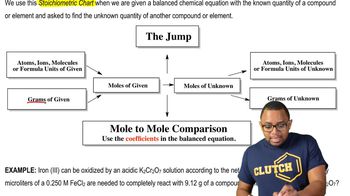
 03:31
03:31