Skip to main content
Analytical Chemistry
My Course
Learn
Exam Prep
AI Tutor
Study Guides
Flashcards
Explore
Try the app
My Course
Learn
Exam Prep
AI Tutor
Study Guides
Flashcards
Explore
Try the app
Back
Weak Acid-Strong Base Titrations definitions
You can tap to flip the card.
Weak Acid
You can tap to flip the card.
👆
Weak Acid
A proton donor that only partially dissociates in water, resulting in a solution with both undissociated molecules and ions.
Track progress
Control buttons has been changed to "navigation" mode.
1/15
Related flashcards
Related practice
Recommended videos
Weak Acid-Strong Base Titrations quiz
Weak Acid-Strong Base Titrations
15 Terms
Weak Acid-Strong Base Titrations
10. Acid-Base Titrations
5 problems
Topic
Weak Base-Strong Acid Titrations
10. Acid-Base Titrations
5 problems
Topic
10. Acid-Base Titrations - Part 1 of 2
4 topics
12 problems
Chapter
10. Acid-Base Titrations - Part 2 of 2
1 topic
3 problems
Chapter
Guided course
07:49
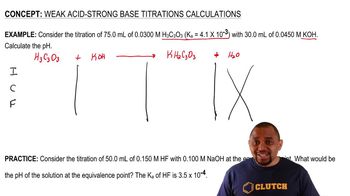
Weak Acid-Strong Base Titrations Calculations 1
377
views
4
rank
Guided course
03:39
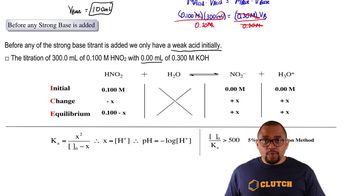
Weak Acid-Strong Base Titrations Calculations 1
373
views
2
rank
Guided course
09:05
Weak Acid-Strong Base Titrations
531
views
2
rank
Terms in this set (15)
Hide definitions
Weak Acid
A proton donor that only partially dissociates in water, resulting in a solution with both undissociated molecules and ions.
Strong Base
A substance that completely dissociates in water, producing a high concentration of hydroxide ions.
Analyte
The chemical species in a titration whose concentration is being determined by reaction with a titrant.
Titrant
A solution of known concentration added to react with the analyte during a titration.
Equivalence Point
The stage in titration where the amount of titrant added exactly reacts with the analyte, resulting in stoichiometric balance.
ICE Chart
A table used to track initial, change, and equilibrium concentrations or moles in a chemical reaction, especially for weak acids or bases.
ICF Chart
A table used to track initial, change, and final moles during reactions involving strong acids or bases, focusing on limiting reactants.
Buffer System
A mixture of a weak acid and its conjugate base that resists changes in pH upon addition of small amounts of acid or base.
Henderson-Hasselbalch Equation
A formula relating pH, pKa, and the ratio of conjugate base to weak acid, useful for buffer calculations.
Conjugate Base
The species formed when a weak acid donates a proton, capable of accepting a proton in reverse reactions.
Ka
The equilibrium constant for the dissociation of a weak acid, indicating its strength in water.
Kb
The equilibrium constant for the dissociation of a weak base, calculated from Kw and Ka for conjugate pairs.
pOH
A measure of hydroxide ion concentration, calculated as the negative logarithm of [OH−] in solution.
Half Equivalence Point
The stage in titration where half the analyte has reacted, resulting in equal concentrations of weak acid and conjugate base.
Limiting Reactant
The reactant that is completely consumed first in a reaction, determining the maximum amount of product formed.
 BackBack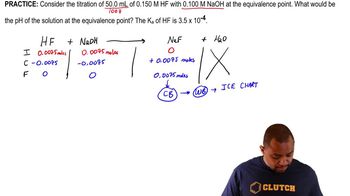
 07:49
07:49