What is the equivalence point in a weak acid-strong base titration?
The equivalence point is where the moles of acid equal the moles of base. At this point, all the weak acid has been neutralized by the strong base.
How do you calculate the equivalence volume in a titration?
Use the formula Macid × Vacid = Mbase × Vbase, solving for the unknown volume. This gives the volume of titrant needed to reach the equivalence point.
What chart do you use to calculate pH before any strong base is added to a weak acid?
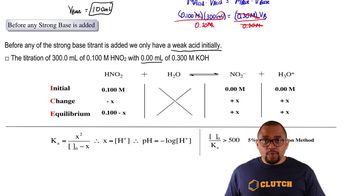
You use an ICE chart (Initial, Change, Equilibrium) when only the weak acid is present. This helps determine the equilibrium concentrations and pH.
What is the purpose of the 5% approximation in ICE chart calculations?
The 5% approximation checks if the change in concentration (x) is small enough to ignore in the denominator. If the initial concentration divided by Ka is greater than 500, you can ignore x.
What equation is used to calculate pH when both weak acid and its conjugate base are present?
The Henderson-Hasselbalch equation is used: pH = pKa + log([conjugate base]/[weak acid]). This applies when the solution acts as a buffer.
At what point in the titration does pH equal pKa?
At the half-equivalence point, pH equals pKa. This is when the concentrations of weak acid and conjugate base are equal.
What chart do you use when both weak acid and strong base are present before the equivalence point?
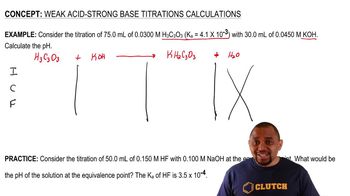
You use an ICF chart (Initial, Change, Final) with units in moles. This helps track the neutralization reaction and remaining species.
What happens to the solution at the equivalence point of a weak acid-strong base titration?
The solution becomes basic because the strong base dictates the pH. The resulting solution contains the conjugate base of the weak acid.
How do you find the pH at the equivalence point for a weak acid-strong base titration?
First, use an ICF chart to find the amount of conjugate base formed, then use an ICE chart for the conjugate base with water. Calculate Kb from Ka and use it to find pOH and then pH.
How is Kb related to Ka for a conjugate base?
Kb = Kw / Ka, where Kw is the ion product of water (1.0 × 10⁻¹⁴). This relationship allows you to find the base dissociation constant from the acid dissociation constant.
What is the main species present after the equivalence point in a weak acid-strong base titration?
After the equivalence point, excess strong base is present. The pH is determined by the concentration of this excess strong base.
How do you calculate pH when excess strong base is present after the equivalence point?
Find the concentration of the remaining strong base, calculate pOH using the negative log, and then subtract pOH from 14 to get pH.
Why do you ignore water in ICF and ICE charts?
Water is ignored because it is a liquid and its concentration does not change significantly during the reaction. It does not affect the equilibrium calculations.
What does the ICF chart track during titration?
The ICF chart tracks the moles of reactants and products before, during, and after the reaction. It helps determine what species remain after neutralization.
Why is only the positive root of the quadratic equation used in ICE chart calculations?
Only the positive root is physically meaningful because concentrations cannot be negative. The negative root is disregarded.
 Back
Back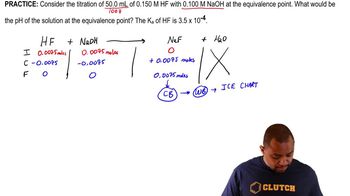
 07:49
07:49