Skip to main content
Anatomy & Physiology
My Course
Learn
Exam Prep
AI Tutor
Study Guides
Textbook Solutions
Flashcards
Explore
Try the app
My Course
Learn
Exam Prep
AI Tutor
Study Guides
Textbook Solutions
Flashcards
Explore
Try the app
Back
Fluid Balance definitions
You can tap to flip the card.
Osmoregulation
You can tap to flip the card.
👆
Osmoregulation
Homeostatic mechanism maintaining solute concentration and water balance, crucial for survival in varying environments.
Track progress
Control buttons has been changed to "navigation" mode.
1/16
Related flashcards
Related practice
Recommended videos
Fluid Balance quiz #1
Fluid Balance
10 Terms
Fluid Balance
26. Fluid and Electrolyte Balance, Acid Base Balance
7 problems
Topic
Jason
Electrolyte Balance
26. Fluid and Electrolyte Balance, Acid Base Balance
7 problems
Topic
Jason
26. Fluid and Electrolyte Balance, Acid Base Balance
3 topics
9 problems
Chapter
Jason
Guided course
02:59
Kidney and Nephron
1821
views
28
rank
1
comments
Guided course
07:16
Osmoregulation and Nitrogenous Waste
2489
views
26
rank
Guided course
11:30
Renin-Angiotensin-Aldosterone-System
1934
views
70
rank
Terms in this set (16)
Hide definitions
Osmoregulation
Homeostatic mechanism maintaining solute concentration and water balance, crucial for survival in varying environments.
Excretory System
Organ system responsible for removing nitrogenous waste and regulating water and solute levels in the body.
Kidney
Bean-shaped organ filtering blood plasma, forming urine, and playing a central role in fluid and electrolyte balance.
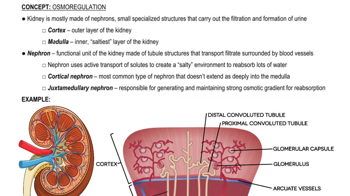
Nephron
Functional unit of the kidney, consisting of tubules and blood vessels, responsible for filtration and reabsorption.
Cortex
Outer layer of the kidney, containing most nephrons and involved in initial filtration processes.
Medulla
Inner region of the kidney, characterized by high salinity and essential for water reabsorption.
Urea
Less toxic nitrogenous waste product formed from ammonia and carbon dioxide, excreted with minimal water loss.
Ammonia
Highly toxic nitrogenous waste requiring significant dilution, commonly excreted by aquatic organisms.
Uric Acid
Nitrogenous waste with low solubility, excreted by organisms in arid environments to conserve water.
Juxtaglomerular Apparatus
Specialized kidney structure containing cells that detect blood pressure changes and initiate hormone release.
Renin
Protein released by kidney cells in response to low blood pressure, triggering a cascade of hormonal events.
Angiotensinogen
Inactive precursor protein produced by the liver, converted into active forms during blood pressure regulation.
Angiotensin II
Potent molecule causing blood vessel constriction, stimulating hormone release, and increasing blood pressure.
Aldosterone
Hormone from the adrenal cortex promoting salt and water reabsorption in the kidney, raising blood volume.
Antidiuretic Hormone
Pituitary hormone enhancing water reabsorption in the kidneys, crucial for maintaining blood volume.
RAAS
Hormonal system integrating kidney, liver, and adrenal signals to regulate blood pressure and fluid balance.
 BackBack
 02:59
02:59