According to the principle of complementarity, how does anatomy relate to physiology?
Ch. 1 The Human Body: An Orientation
All textbooks
Elaine N. Marieb, Katja Hoehn 7th Edition
Ch. 1 The Human Body: An Orientation
Problem 11
Elaine N. Marieb, Katja Hoehn 7th Edition
Ch. 1 The Human Body: An Orientation
Problem 11Chapter 1, Problem 11
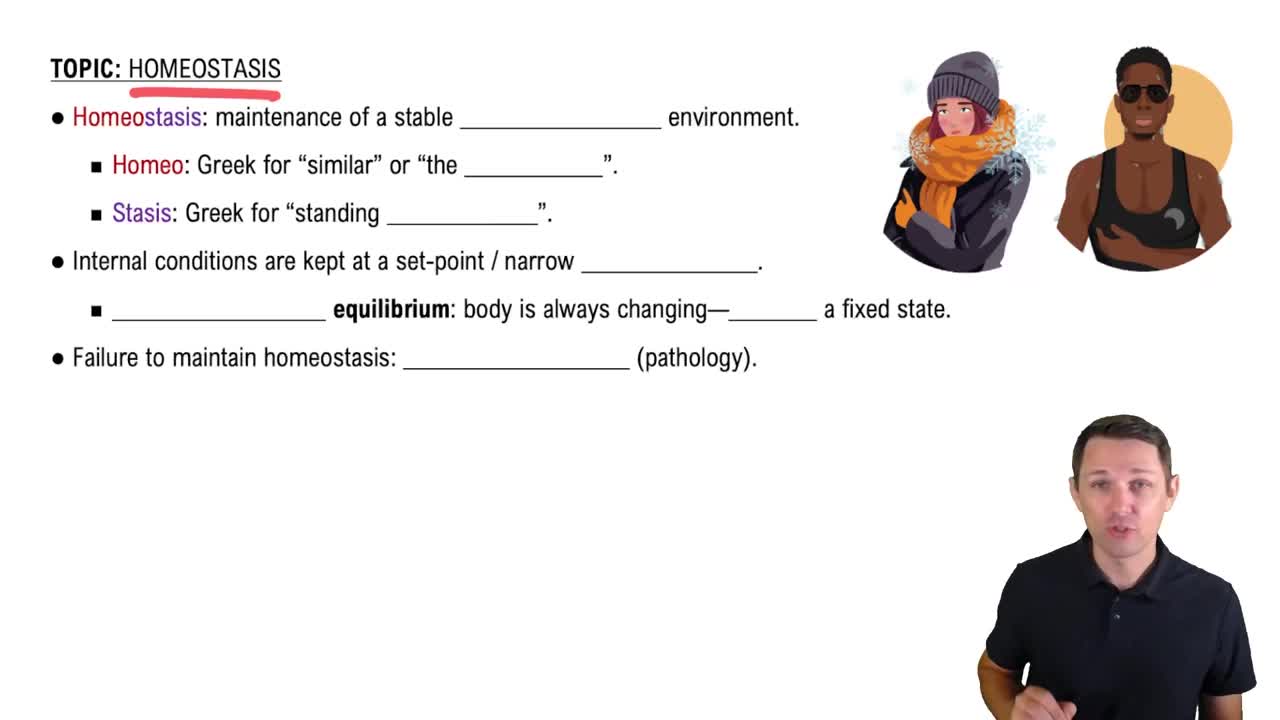
Define homeostasis.
Verified step by step guidance1
Understand that homeostasis is a fundamental concept in Anatomy & Physiology referring to the body's ability to maintain a stable internal environment despite external changes.
Recognize that homeostasis involves various physiological processes that regulate factors such as temperature, pH, hydration, and electrolyte balance.
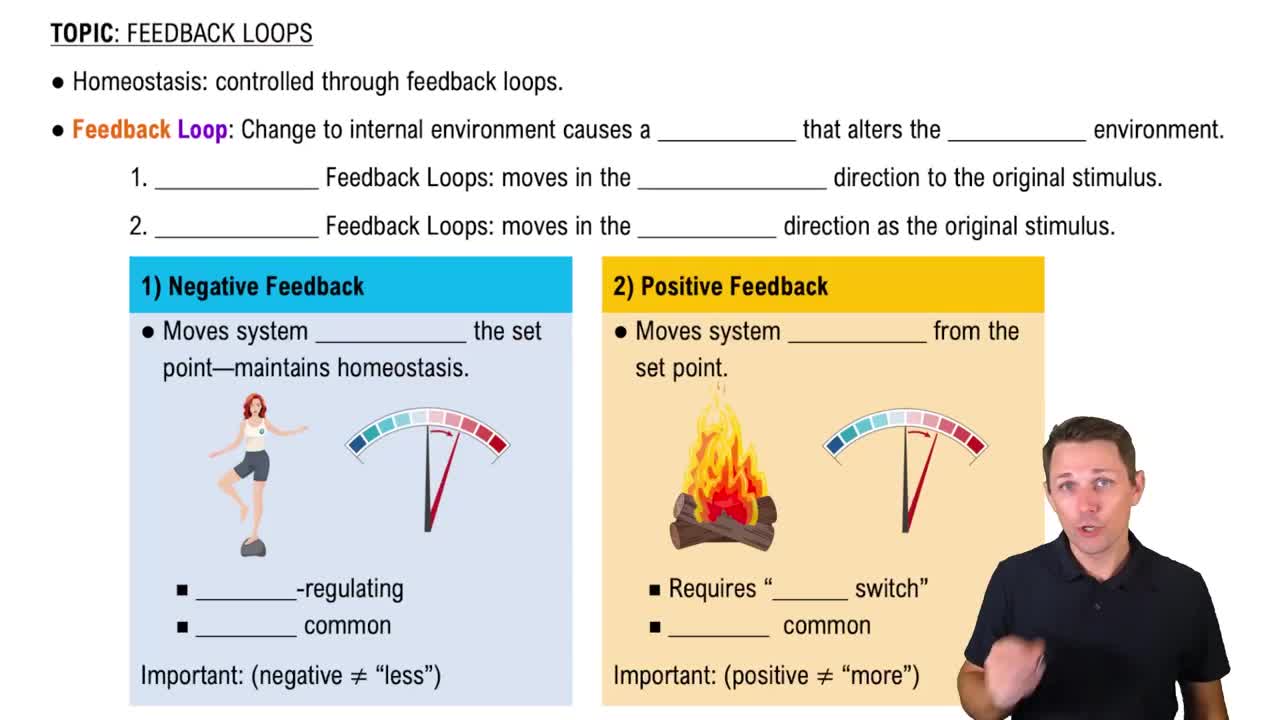
Note that homeostasis is maintained through feedback mechanisms, primarily negative feedback loops, which detect deviations from a set point and initiate responses to correct them.
Consider examples such as regulation of body temperature by sweating or shivering, and blood glucose levels controlled by insulin and glucagon.
Summarize by defining homeostasis as the dynamic process by which the body maintains internal stability to ensure optimal functioning of cells and organs.

Verified video answer for a similar problem:
This video solution was recommended by our tutors as helpful for the problem above.
Video duration:
1mWas this helpful?
Key Concepts
Here are the essential concepts you must grasp in order to answer the question correctly.
Homeostasis
Homeostasis is the process by which living organisms maintain a stable internal environment despite changes in external conditions. It involves regulating factors like temperature, pH, and glucose levels to keep bodily functions within optimal ranges.
Recommended video:
Guided course
Introduction to Homeostasis
Feedback Mechanisms
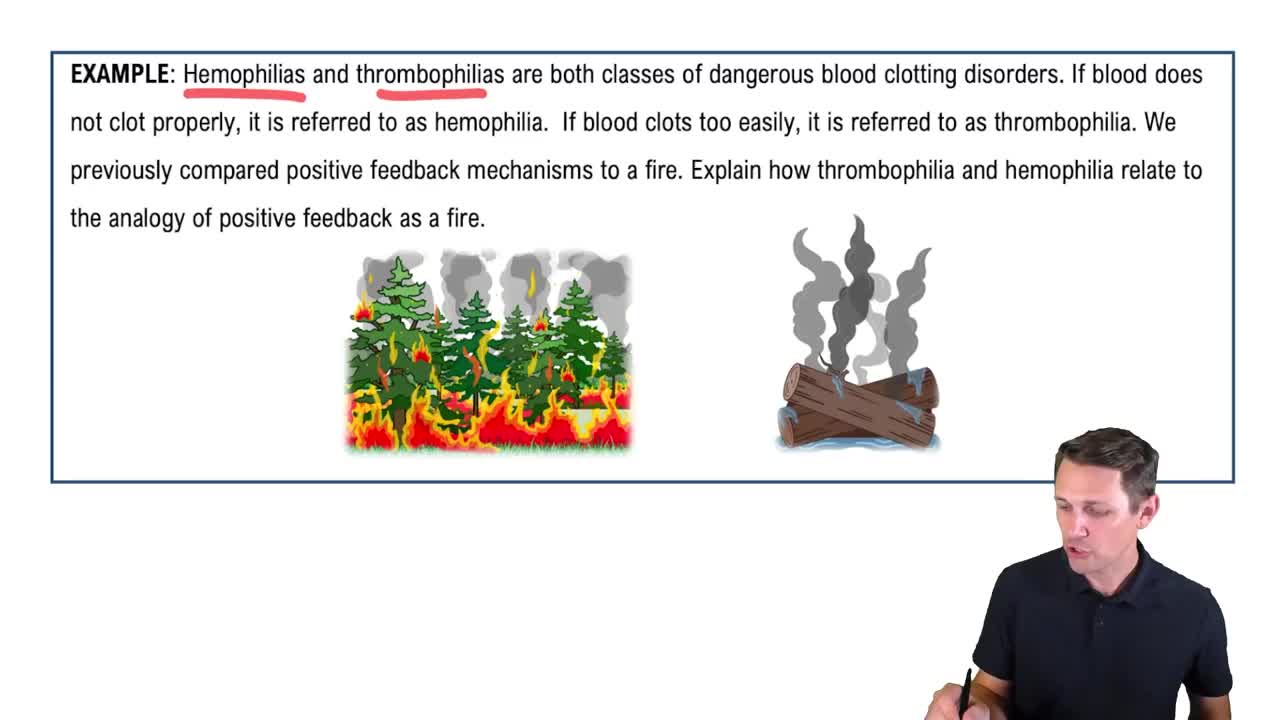
Feedback mechanisms are biological processes that help maintain homeostasis. Negative feedback reduces deviations from a set point, restoring balance, while positive feedback amplifies changes, usually to complete a specific process.
Recommended video:
Guided course
Feedback Loops: Positive Feedback Example 1
Set Point
The set point is the ideal value or range for a physiological parameter that the body strives to maintain. For example, human body temperature is typically regulated around 37°C, and deviations trigger responses to return to this set point.
Recommended video:
Guided course
Introduction to Feedback Loops
Related Practice
Textbook Question
2535
views
1
rank
Textbook Question
Construct a table that lists the 11 systems of the body, names two organs of each system (if appropriate), and describes the overall or major function of each system.
1680
views
2
rank
Textbook Question
List and describe briefly five external factors that must be present or provided to sustain life.
1443
views
1
rank
Textbook Question
Define plane and section.
897
views
Textbook Question
Provide the anatomical term that correctly names each of the following body regions:
a. Arm
b. Thigh
c. Chest
d. Fingers and toes
e. Anterior aspect of the knee
2523
views
1
rank
Textbook Question
a. Make a diagram showing the nine abdominopelvic regions, and name each region. Name two organs (or parts of organs) that could be located in each of the named regions.
b. Make a similar sketch illustrating how the abdominopelvic cavity may be divided into quadrants, and name each quadrant.
1661
views