Ch. 17 Blood
Chapter 16, Problem 23

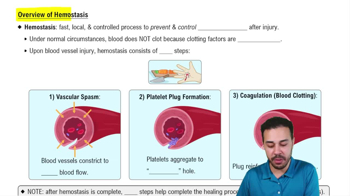
Define hemostasis
List the three major phases of coagulation. Explain what initiates each phase and what the phase accomplishes
In what general way do the intrinsic and extrinsic mechanisms of clotting differ?
Which ion is essential to virtually all stages of coagulation?

Verified step by step guidance
1
Define hemostasis as the physiological process that stops bleeding at the site of an injury, involving blood vessel constriction, platelet plug formation, and blood clotting to maintain vascular integrity.
List the three major phases of coagulation: (1) Vascular spasm, (2) Platelet plug formation, and (3) Coagulation (blood clotting). Explain that vascular spasm is initiated by blood vessel injury causing vasoconstriction to reduce blood flow; platelet plug formation is triggered by exposed collagen fibers attracting platelets that adhere and aggregate; coagulation is initiated by a cascade of clotting factors leading to fibrin mesh formation that stabilizes the clot.
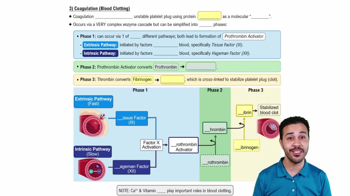
Describe the intrinsic and extrinsic pathways of coagulation: the intrinsic pathway is activated by damage inside the blood vessel and involves clotting factors present in the blood, while the extrinsic pathway is triggered by external trauma exposing tissue factor (factor III) from damaged tissues outside the vessel.
Explain that both intrinsic and extrinsic pathways converge on the common pathway, leading to the activation of factor X, which ultimately converts prothrombin to thrombin, and fibrinogen to fibrin, forming a stable clot.
Identify calcium ion (Ca^{2+}) as the essential ion required for virtually all stages of coagulation, as it acts as a cofactor for multiple clotting factors and enzymatic reactions in the cascade.

Verified video answer for a similar problem:

This video solution was recommended by our tutors as helpful for the problem above.
Video duration:
7m
Was this helpful?

Key Concepts

Here are the essential concepts you must grasp in order to answer the question correctly.

Hemostasis

Hemostasis is the physiological process that stops bleeding at the site of an injured blood vessel. It involves blood vessel constriction, platelet plug formation, and blood coagulation to prevent excessive blood loss while maintaining blood flow elsewhere.
Recommended video:
4:28
Overview of Hemostasis

Phases of Coagulation

Coagulation occurs in three major phases: the vascular phase (vasoconstriction to reduce blood flow), the platelet phase (platelet adhesion and aggregation forming a temporary plug), and the coagulation phase (activation of clotting factors leading to fibrin mesh formation that stabilizes the clot). Each phase is initiated by vessel injury and exposure of underlying tissues.
Recommended video:
03:21
Phases of Mitosis

Intrinsic vs. Extrinsic Clotting Pathways and Role of Calcium Ion

The intrinsic pathway is activated by damage inside the blood vessel and involves clotting factors present in the blood, while the extrinsic pathway is triggered by external trauma exposing tissue factor. Both pathways converge to form a common pathway. Calcium ions (Ca2+) are essential cofactors required at multiple steps in both pathways to enable clotting factor activation and fibrin formation.
Recommended video:
10:05
Coagulation (Blood Clotting)
Related Practice
Textbook Question

How can poor nutrition lead to anemia?

512
views
Textbook Question

Alan Forsythe, a middle-aged college professor from Boston, is in the Swiss Alps studying astronomy during his sabbatical leave. He has been there for two days and plans to stay the entire year. However, he notices that he is short of breath when he walks up steps and tires easily with any physical activity. His symptoms gradually disappear, and he feels fine after less than a month. Upon returning to the United States, he has a complete physical exam and is told that his erythrocyte count is higher than normal.

a. Attempt to explain this finding.

b. Will his RBC count remain at this higher-than-normal level? Why or why not?

492
views
Textbook Question

Discuss hemoglobin relative to its chemical structure, its function, and the color changes it undergoes during loading and unloading of oxygen.

753
views
Textbook Question

Cancer patients being treated with chemotherapeutic drugs designed to destroy rapidly dividing cells are monitored closely for changes in their red and white blood counts. Why so?

585
views
Textbook Question

Amanda Healy, a young woman with severe vaginal bleeding, is admitted to the emergency room. She is three months pregnant, and the physician is concerned about the volume of blood she is losing.

What type of transfusion will probably be given to this patient?

Which blood tests will be performed before starting the transfusion?

14
views
Textbook Question

A reticulocyte count indicated that 5% of Tyler's red blood cells were reticulocytes. His blood test also indicated he had polycythemia and a hematocrit of 65%. Explain the connection between these three facts.

62
views