Back

Alpha Helix Disruption quiz

Control buttons has been changed to "navigation" mode.
1/15
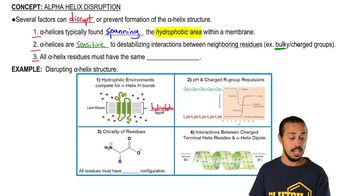
  • What type of environment favors the formation of alpha helices in proteins?

    Hydrophobic environments, such as the interior of membranes, favor alpha helix formation.
  • How do hydrophilic environments disrupt alpha helices?

    Hydrophilic environments compete for hydrogen bonds, causing the protein backbone to form hydrogen bonds with water instead of itself, disrupting the alpha helix.
  • What effect do bulky amino acid residues have on alpha helix stability?

    Bulky residues cause steric hindrance, which can destabilize and disrupt the alpha helix structure.
  • How do charged amino acid side chains affect alpha helix stability at certain pH levels?

    Charged side chains can repel each other at certain pH levels, leading to destabilization and disruption of the alpha helix.
  • Why does polyglutamate lose its alpha helix structure at high pH?

    At high pH, glutamate side chains become negatively charged and repel each other, causing the structure to shift from an alpha helix to a random coil.
  • What happens to polylysine's alpha helix structure at low pH?

    At low pH, lysine side chains are positively charged and repel each other, disrupting the alpha helix and leading to a random conformation.
  • Why must all residues in an alpha helix have the same chirality?

    Alpha helices require uniform chirality; the presence of a D-amino acid among L-amino acids disrupts the helix structure.
  • How does the dipole nature of the alpha helix affect its stability?

    The alpha helix has a partial positive charge at the amino terminus and a partial negative charge at the carboxyl terminus, so placing like charges near these ends destabilizes the helix.
  • What effect does placing negatively charged residues near the carboxyl end of an alpha helix have?

    It destabilizes the alpha helix because like charges repel each other.
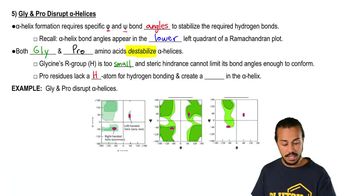
  • Why are glycine residues disruptive to alpha helices?

    Glycine's small size and flexible bond angles make it difficult to maintain the specific angles required for alpha helix formation.
  • What is the main reason proline disrupts alpha helices?

    Proline lacks a hydrogen atom on its amino group, preventing it from forming the necessary hydrogen bonds for alpha helix stability.
  • Which is more disruptive to alpha helices: glycine or proline?

    Proline is significantly more disruptive to alpha helices than glycine.
  • How does proline's structure contribute to its disruptive effect on alpha helices?

    Proline's cyclic structure connects its side chain to the amino group, eliminating the hydrogen needed for backbone hydrogen bonding.
  • Where do the bond angles for alpha helices appear on a Ramachandran plot?

    Alpha helix bond angles appear in the lower left quadrant of the Ramachandran plot.
  • Why are prolines rarely found in alpha helices?

    Prolines disrupt alpha helices by creating kinks and preventing necessary hydrogen bonding, making them highly unfavorable in helix structures.