Back

Anfinsen Experiment definitions

Control buttons has been changed to "navigation" mode.
1/15
  • Primary Structure

    Linear sequence of amino acids in a protein, determining all higher levels of structure and proper folding.
  • Tertiary Structure

    Three-dimensional shape of a protein formed by interactions among side chains, crucial for function.
  • Native Conformation

    Most stable, functional form of a protein, achieved after correct folding and bond formation.
  • Protein Folding

    Process by which a polypeptide adopts its functional three-dimensional structure, driven by sequence.
  • Exergonic Process

    Thermodynamically favorable reaction releasing energy, such as spontaneous protein folding.
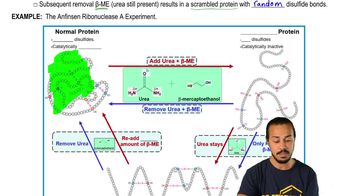
  • Urea

    Chemical agent disrupting non-covalent bonds in proteins, leading to loss of structure and function.
  • Beta-Mercaptoethanol

    Reagent breaking disulfide bonds in proteins, essential for denaturation and studying folding.
  • Ribonuclease A

    Enzyme used in Anfinsen's experiment, whose folding and activity depend on proper structure.
  • Disulfide Bond

    Covalent linkage between cysteine residues, stabilizing protein structure and influencing activity.
  • Non-Covalent Interaction

    Forces such as hydrogen bonds and van der Waals interactions, crucial for correct protein folding.
  • Denaturation

    Loss of native protein structure and function due to disruption of bonds by chemical agents.
  • Renaturation

    Restoration of a protein's native structure and activity after removal of denaturing agents.
  • Catalytic Activity

    Ability of a protein, especially enzymes, to perform its biological function efficiently.
  • Dialysis

    Technique used to remove small molecules like urea and beta-mercaptoethanol from protein solutions.
  • Scrambled Protein

    Misfolded protein with incorrect disulfide bonds, resulting in reduced or lost biological activity.