Back

Chaperone Proteins quiz

Control buttons has been changed to "navigation" mode.
1/15
  • Why do large proteins often require assistance to fold in the cellular environment?

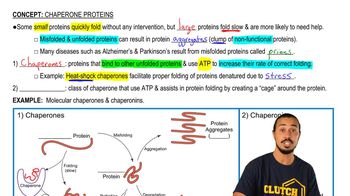
    Large proteins fold slowly, increasing the risk of improper interactions and misfolding due to the crowded cellular environment.
  • What are protein aggregates and why are they problematic?

    Protein aggregates are clumps of misfolded proteins that are nonfunctional and can lead to diseases such as Alzheimer's and Parkinson's.
  • What is the role of chaperone proteins in protein folding?

    Chaperone proteins bind to unfolded proteins and use ATP to accelerate correct folding, preventing misfolding and aggregation.
  • How do chaperone proteins prevent misfolding?

    They physically bind to unfolded proteins, blocking other molecules from interfering with the folding process.
  • What is the significance of ATP in the function of chaperone proteins?

    ATP provides the energy needed for chaperone proteins to increase the rate of proper protein folding.
  • What are prions and how are they related to protein misfolding?

    Prions are misfolded protein aggregates that can cause diseases like Alzheimer's and Parkinson's.
  • What are heat shock chaperones and what types of stress do they respond to?

    Heat shock chaperones help refold proteins denatured by various cellular stresses, including heat, pH changes, temperature shifts, and UV radiation.
  • Why is the name 'heat shock chaperones' considered misleading?

    Because they assist in refolding proteins denatured by many types of stress, not just heat.
  • What distinguishes chaperonins from other chaperone proteins?

    Chaperonins encapsulate unfolded proteins in a cage-like structure, providing an isolated environment for proper folding.
  • How do chaperonins use ATP in their function?

    Chaperonins use ATP to create and maintain the cage structure that isolates unfolded proteins for correct folding.
  • Can chaperone proteins refold misfolded proteins?

    Yes, some chaperone proteins can interact with misfolded proteins and refold them back into their native shape.
  • What is another cellular strategy to prevent protein aggregation besides chaperone proteins?

    Cells can mark misfolded proteins for degradation, breaking them down into harmless fragments.
  • Are chaperone proteins involved in marking proteins for degradation?

    No, chaperone proteins are not involved in marking proteins for degradation; this is a separate cellular process.
  • Why is rapid protein folding important in cells?

    Rapid folding reduces the chance of improper interactions and misfolding, preventing disease-causing aggregates.
  • What happens to proteins that are produced in an unfolded state?

    They may require chaperone proteins to fold correctly and avoid misfolding or aggregation.