Back

Edman Degradation Reaction Efficiency definitions

Control buttons has been changed to "navigation" mode.
1/15
  • Edman Degradation

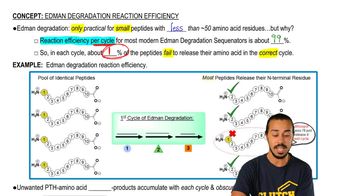
    A sequencing method for small peptides, limited by efficiency and accumulation of side products with each cycle.
  • Reaction Efficiency

    The percentage of successful reactions per cycle, typically 99%, determining the reliability of amino acid release.
  • Peptide Fragment

    A short chain of amino acids, often produced by cleaving larger proteins to enable accurate sequencing.
  • Amino Acid Residue

    A single unit within a peptide chain, revealed one at a time during sequencing cycles.
  • N-terminal

    The end of a peptide chain where sequencing begins, marked by a free amino group.
  • PTH Amino Acid

    The derivative identified after each cycle, indicating the released amino acid from the peptide.
  • Phenyl Isothiocyanate

    A reagent used to initiate the first step of the sequencing reaction, targeting the N-terminal amino acid.
  • Trifluoroacetic Acid

    A chemical used in the second step to facilitate the release of the modified amino acid from the peptide.
  • Cumulative Yield

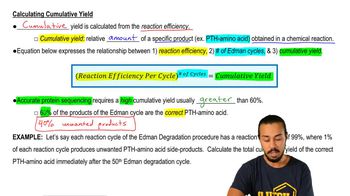
    The proportion of correct final products after multiple cycles, calculated by raising efficiency to the cycle number.
  • Side Product

    An unwanted derivative formed when sequencing fails, accumulating and obscuring results with each cycle.
  • Protein Sequencing

    The process of determining the order of amino acids in a protein, requiring high cumulative yield for accuracy.
  • Chemical Cleavage

    A technique used to break large proteins into smaller fragments suitable for sequencing.
  • Peptidase

    An enzyme that cleaves peptide bonds, aiding in fragmenting proteins for sequencing.
  • Hydrolysis

    A method for breaking peptide bonds, producing fragments for sequencing analysis.
  • Sequencing Threshold

    The minimum cumulative yield, typically 60%, required for reliable identification of amino acid sequence.