Back

Edman Degradation Reaction Efficiency quiz

Control buttons has been changed to "navigation" mode.
1/15
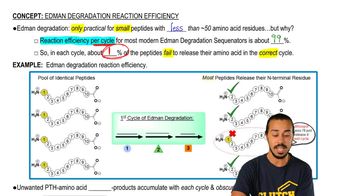
  • Why is Edman degradation limited to peptides with fewer than 50 amino acid residues?

    Because the reaction efficiency per cycle is 99%, errors accumulate with each cycle, making sequencing of longer peptides inaccurate.
  • What is the reaction efficiency per cycle for most modern Edman degradation sequenators?

    The reaction efficiency per cycle is about 99%.
  • What happens to the 1% of peptides that fail to release their N-terminal amino acid in each Edman degradation cycle?

    They accumulate as side products, contaminating subsequent cycles and obscuring sequencing results.
  • Why must large proteins be cleaved into smaller fragments before Edman degradation?

    Large proteins must be cleaved because Edman degradation is only accurate for peptides with fewer than 50 residues due to cumulative errors.
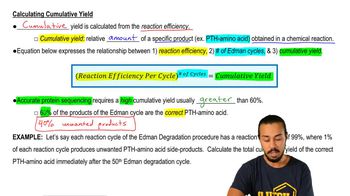
  • What is cumulative yield in the context of Edman degradation?

    Cumulative yield is the proportion of correct final products obtained after all cycles, calculated as (reaction efficiency)^(number of cycles).
  • How do you calculate cumulative yield from reaction efficiency and number of cycles?

    Raise the reaction efficiency (as a decimal) to the power of the number of Edman degradation cycles.
  • What cumulative yield is generally required for accurate protein sequencing?

    A cumulative yield of 60% or higher is required for accurate sequencing.
  • What does a cumulative yield of 60% mean in Edman degradation?

    It means 60% of the products are the correct PTH amino acid, while 40% are unwanted side products.
  • What is the effect of increasing the number of Edman degradation cycles beyond 50 at 99% efficiency?

    The cumulative yield drops below 60%, risking inaccurate protein sequencing.
  • What chemical is used to initiate the first reaction in Edman degradation?

    Phenyl isothiocyanate (PITC) is used to initiate the first reaction.
  • What is the main side product that accumulates during Edman degradation?

    Unwanted PTH amino acids accumulate as side products.
  • Why do side products in Edman degradation obscure sequencing results?

    Because they contaminate subsequent cycles, making it difficult to identify the correct amino acid sequence.
  • What happens if a peptide fails to release its N-terminal residue in the correct cycle?

    It may release it in a later cycle, contaminating the results with incorrect PTH amino acids.
  • If the reaction efficiency is 99% and there are 50 cycles, what is the cumulative yield?

    The cumulative yield is about 60.5%.
  • What is the risk if the cumulative yield falls below 60% in Edman degradation?

    There is a significant risk of inaccurate protein sequencing due to excessive side products.