Back

Simple Vs. Conjugated Proteins definitions

Control buttons has been changed to "navigation" mode.
1/14
  • Simple Protein

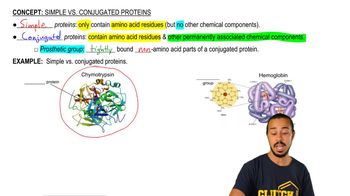
    Molecule composed exclusively of amino acid residues, lacking any additional chemical components or prosthetic groups.
  • Conjugated Protein

    Molecule containing amino acid residues and a permanently associated non-amino acid component known as a prosthetic group.
  • Amino Acid Residue

    Structural unit within proteins, derived from amino acids, forming the backbone of both simple and conjugated proteins.
  • Prosthetic Group

    Tightly bound, non-amino acid component of a protein, essential for its function and classification as conjugated.
  • Chymotrypsin

    Enzyme example of a simple protein, consisting solely of amino acid residues and lacking any prosthetic group.
  • Hemoglobin

    Heterotetrameric protein with a heme prosthetic group, responsible for oxygen transport in blood.
  • Heme Group

    Prosthetic group containing iron and cyclic carbon rings, found in hemoproteins like hemoglobin and myoglobin.
  • Lipoprotein

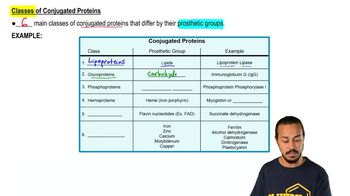
    Class of conjugated protein with a lipid prosthetic group, involved in fatty acid metabolism.
  • Glycoprotein

    Class of conjugated protein with a carbohydrate prosthetic group, exemplified by immunoglobulin G.
  • Phosphoprotein

    Class of conjugated protein with a phosphate prosthetic group, such as phosphorylase 1, important in glycogen regulation.
  • Hemoprotein

    Class of conjugated protein with a heme prosthetic group, including myoglobin and hemoglobin.
  • Flavoprotein

    Class of conjugated protein with a flavonucleotide prosthetic group, such as FAD, found in enzymes like succinate dehydrogenase.
  • Metalloprotein

    Class of conjugated protein with a metal prosthetic group, examples include ferritin and alcohol dehydrogenase.
  • Heterotetramer

    Protein structure composed of four subunits, with at least two distinct types, as seen in hemoglobin.