Back

Simple Vs. Conjugated Proteins quiz

Control buttons has been changed to "navigation" mode.
1/15
  • What is the main difference between simple and conjugated proteins?

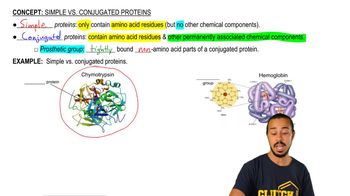
    Simple proteins contain only amino acid residues, while conjugated proteins contain amino acids plus additional non-amino acid components called prosthetic groups.
  • What is a prosthetic group in the context of proteins?

    A prosthetic group is a tightly bound, non-amino acid component that is permanently associated with a conjugated protein.
  • Which protein is given as an example of a simple protein in the lesson?

    Chymotrypsin is given as an example of a simple protein.
  • Why is chymotrypsin classified as a simple protein?

    Chymotrypsin is classified as a simple protein because it contains only amino acid residues and no other chemical components.
  • What structural features are found in chymotrypsin?

    Chymotrypsin contains alpha helices, beta pleated sheets, loops, and beta turns, but no non-amino acid components.
  • Which protein is used as an example of a conjugated protein?

    Hemoglobin is used as an example of a conjugated protein.
  • What prosthetic group is found in hemoglobin?

    Hemoglobin contains a heme group as its prosthetic group.
  • What elements are found in the heme group of hemoglobin?

    The heme group contains iron atoms and cyclic carbon rings.
  • How many main classes of conjugated proteins are there?

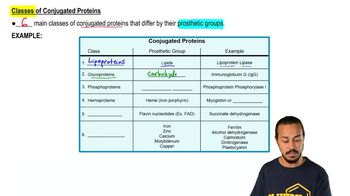
    There are six main classes of conjugated proteins.
  • What distinguishes the different classes of conjugated proteins?

    The different classes are distinguished by the type of prosthetic group they contain.
  • What is the prosthetic group in lipoproteins, and what is their function?

    Lipoproteins have lipid prosthetic groups and are critical in fatty acid metabolism.
  • What is the prosthetic group in glycoproteins, and give an example?

    Glycoproteins have carbohydrate prosthetic groups; an example is immunoglobulin G (IgG).
  • What is the prosthetic group in phosphoproteins, and name an example?

    Phosphoproteins have phosphate groups as prosthetic groups; an example is phosphorylase 1.
  • What is the prosthetic group in flavoproteins, and give an example?

    Flavoproteins have flavonucleotide prosthetic groups, such as FAD; an example is succinate dehydrogenase.
  • What are metalloproteins, and list some metals that can serve as their prosthetic groups?

    Metalloproteins have metal ions as prosthetic groups, such as iron, zinc, calcium, molybdenum, and copper.