Back

Size Exclusion Chromatography quiz

Control buttons has been changed to "navigation" mode.
1/15
  • What is another name for size exclusion chromatography?

    Size exclusion chromatography is also known as gel filtration chromatography.
  • What is the stationary phase in size exclusion chromatography made of?

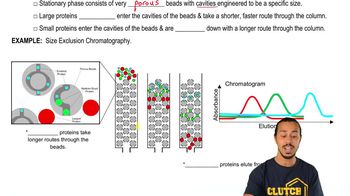
    The stationary phase consists of porous beads with cavities of specific sizes.
  • How does size exclusion chromatography separate proteins?

    It separates proteins based on their size.
  • Why do larger proteins elute first in size exclusion chromatography?

    Larger proteins cannot enter the cavities of the beads and thus travel around them, taking a shorter and faster route through the column.
  • Why do smaller proteins elute last in size exclusion chromatography?

    Smaller proteins enter the cavities of the beads, taking a longer path and thus eluting last.
  • What does the chromatogram in size exclusion chromatography plot?

    It plots light absorbance (y-axis) against elution time (x-axis).
  • How can size exclusion chromatography be used to determine the size of an unknown protein?

    If the sizes of other proteins are known, the elution time of the unknown protein can be compared to estimate its size.
  • What is the main difference between gel electrophoresis and gel filtration chromatography regarding protein movement?

    In gel filtration chromatography, larger proteins elute first, whereas in gel electrophoresis, smaller molecules typically move faster.
  • What role do the pores in the beads play in size exclusion chromatography?

    The pores create different pathways for proteins, allowing smaller proteins to enter and be delayed, while larger proteins bypass them.
  • What happens to intermediate-sized proteins in size exclusion chromatography?

    Intermediate-sized proteins can enter some, but not all, of the pores, so they elute between the large and small proteins.
  • What is the order of elution for proteins of different sizes in size exclusion chromatography?

    Large proteins elute first, followed by intermediate-sized proteins, and then small proteins elute last.
  • How does the path length through the column differ for large and small proteins?

    Large proteins take a shorter path around the beads, while small proteins take a longer path through the bead cavities.
  • What is measured at the bottom of the column in size exclusion chromatography?

    The absorbance of the molecules as they elute from the column is measured.
  • Why can't large proteins enter the bead cavities in size exclusion chromatography?

    Large proteins are physically too big to fit into the cavities of the beads.
  • What is the main purpose of using size exclusion chromatography in protein purification?

    It is used to purify proteins based on their size.