
A friend says, 'Geneticists spend all their time talking about DNA, but that's silly because DNA really isn't that important in the functions of a cell.' In what ways is she right, and in what ways might she be wrong?
Verified step by step guidance
1
Step 1: Let's first understand the importance of DNA. DNA, or deoxyribonucleic acid, is the molecule that contains the genetic code of organisms. This includes animals, plants, protists, archaea and bacteria. DNA is in each cell in the organism and tells cells what proteins to make. Mostly, these proteins are enzymes. DNA is essential for life and its roles in the day to day functioning of the cell, in growth, reproduction and maintenance are vital.
Step 2: Now, let's consider the ways in which your friend might be right. While DNA is crucial for the functioning of a cell, it is not the only important component. Other structures, such as the mitochondria, endoplasmic reticulum, and ribosomes, also play key roles in cellular function. For example, mitochondria are responsible for energy production, ribosomes are involved in protein synthesis, and the endoplasmic reticulum assists in processing molecules created by the cell.
Step 3: Additionally, RNA, or ribonucleic acid, also plays a significant role in protein synthesis. RNA is a molecule similar to DNA that is used in various vital roles in coding, decoding, regulation and expression of genes. The actual process of protein synthesis, the primary function of cells, is performed by RNA, not DNA.
Step 4: Now, let's consider the ways in which your friend might be wrong. While it's true that other cellular components are important for the cell's function, none of them could perform their roles without the instructions provided by DNA. DNA holds the instructions for the creation and operation of all cells, tissues, organs, and indeed, the entire organism. Without DNA, the cell would lack the necessary information to function.
Step 5: In conclusion, while DNA is not the only important component of a cell, it is absolutely crucial for the cell's function. It provides the instructions for all of the cell's activities. Without DNA, a cell would not know how to function, and life as we know it could not exist.
Verified video answer for a similar problem:
This video solution was recommended by our tutors as helpful for the problem above
Video duration:
2m
Play a video:
Was this helpful?
Key Concepts
Here are the essential concepts you must grasp in order to answer the question correctly.
Role of DNA in Cellular Function
DNA serves as the blueprint for all cellular functions by encoding the genetic information necessary for the synthesis of proteins. These proteins perform a vast array of functions, including catalyzing biochemical reactions, providing structural support, and regulating cellular processes. While DNA is crucial, it is not the sole determinant of cellular function, as other factors like RNA and proteins also play significant roles.
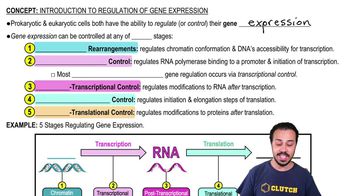
Gene expression is the process by which information from a gene is used to synthesize functional gene products, typically proteins. This process is tightly regulated, meaning that not all genes are expressed at all times or in all cells. Factors such as environmental signals, cellular conditions, and epigenetic modifications influence gene expression, highlighting that DNA's role is part of a larger regulatory network.
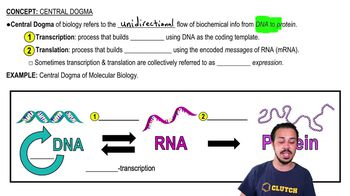
The Central Dogma describes the flow of genetic information within a biological system, typically summarized as DNA -> RNA -> Protein. This framework illustrates how DNA is transcribed into messenger RNA (mRNA), which is then translated into proteins. While this model emphasizes the importance of DNA, it also underscores the critical roles of RNA and proteins in executing cellular functions, suggesting that DNA alone does not dictate cellular activity.