Pearson+ LogoPearson+ Logo
Ch. 16 - How Genes Work
Freeman - Biological Science 7th Edition
Freeman7th EditionBiological ScienceISBN: 9783584863285Not the one you use?Change textbook
Chapter 16, Problem 4

Which of the following describes the experimental strategy that was used to decipher the genetic code?a. comparing the amino acid sequences of proteins with the base sequence of their genesb. analyzing the sequence of RNAs produced from known DNA sequencesc. analyzing mutants that changed the coded. examining the polypeptides produced when RNAs with particular sequences were translated

Verified step by step guidance
1
Identify the main goal of the experimental strategy in question, which is to decipher the genetic code. The genetic code is the set of rules by which information encoded in genetic material (DNA or RNA sequences) is translated into proteins by living cells.
Consider the method that directly involves the translation process of RNA into proteins, as the genetic code is fundamentally about how sequences of nucleotides in RNA dictate the sequence of amino acids in proteins.
Evaluate option d, which mentions examining the polypeptides produced when RNAs with particular sequences were translated. This directly relates to observing how specific RNA sequences are decoded into protein sequences.
Understand that by using synthetic RNAs of known sequences and observing the resulting polypeptides, scientists could directly determine which codons (specific sequences of three RNA nucleotides) correspond to which amino acids, thus deciphering the genetic code.
Conclude that the experimental strategy described in option d is the most direct and relevant method for deciphering the genetic code, as it involves directly translating RNA sequences into proteins and observing the outcome.

Verified video answer for a similar problem:

This video solution was recommended by our tutors as helpful for the problem above.
Video duration:
2m
Was this helpful?

Key Concepts

Here are the essential concepts you must grasp in order to answer the question correctly.

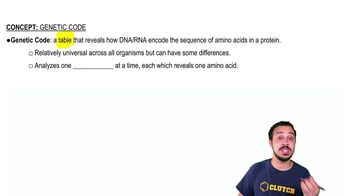
Genetic Code

The genetic code is the set of rules by which information encoded in genetic material (DNA or RNA) is translated into proteins. It consists of codons, which are sequences of three nucleotides that correspond to specific amino acids. Understanding the genetic code is essential for deciphering how genes dictate the synthesis of proteins, which are crucial for cellular functions.
Recommended video:

Transcription and Translation

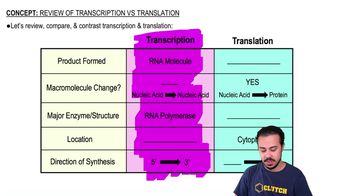
Transcription is the process by which the information in a DNA sequence is copied into messenger RNA (mRNA), while translation is the subsequent process where ribosomes synthesize proteins based on the mRNA sequence. These two processes are fundamental to gene expression and are critical for understanding how genetic information is converted into functional products.
Recommended video:
Guided course
04:07
Review of Transcription vs. Translation

Mutagenesis

Mutagenesis refers to the process of inducing changes or mutations in the DNA sequence, which can lead to alterations in protein function. By analyzing mutants, researchers can identify how specific changes in the genetic code affect the resulting proteins, providing insights into the relationship between genotype and phenotype, and helping to elucidate the genetic code.
Related Practice
Textbook Question

DNA's primary structure is made up of just four different bases, and its secondary structure is regular and highly stable. How can a molecule with these characteristics hold the information required to build and maintain a cell?

1266
views
Textbook Question
DNA's primary structure is made up of just four different bases, and its secondary structure is regular and highly stable. How can a molecule with these characteristics hold the information required to build and maintain a cell?
1921
views
Textbook Question

Which of the following describes the experimental strategy that was used to decipher the genetic code?

a. Comparing the amino acid sequences of proteins with the base sequence of their genes

b. Analyzing the sequence of RNAs produced from known DNA sequences

c. Analyzing mutants that changed the code

d. Examining the polypeptides produced when RNAs with particular sequences were translated

837
views
Textbook Question

A friend says, 'Geneticists spend all their time talking about DNA, but that's silly because DNA really isn't that important in the functions of a cell.' In what ways is she right, and in what ways might she be wrong?

952
views
Textbook Question
A friend says, 'Geneticists spend all their time talking about DNA, but that's silly because DNA really isn't that important in the functions of a cell.' In what ways is she right, and in what ways might she be wrong?
1265
views
Textbook Question

A minimal genetic code requires only 21 codons—one for each amino acid, and one for a stop signal. Given this, what advantage might be offered by having a code with 64 codons?

986
views