
Pearson+ LogoPearson+ Logo
Ch. 16 - How Genes Work
Freeman - Biological Science 7th Edition
Freeman7th EditionBiological ScienceISBN: 9783584863285Not the one you use?Change textbook
Chapter 16, Problem 3

DNA's primary structure is made up of just four different bases, and its secondary structure is regular and highly stable. How can a molecule with these characteristics hold the information required to build and maintain a cell?

Verified step by step guidance
1
Understand the components of DNA: DNA is composed of four nucleotide bases—adenine (A), thymine (T), cytosine (C), and guanine (G). These bases pair specifically (A with T, and C with G) to form the rungs of the DNA double helix ladder.
Recognize the significance of the sequence of bases: The order of these bases along the DNA strand encodes genetic information. This sequence is what determines the genetic instructions used in the development, functioning, and reproduction of all known organisms and many viruses.
Explore the concept of genes: A gene is a segment of DNA that contains the instructions for making a specific protein or set of proteins. The different combinations and sequences of the nucleotide bases (A, T, C, G) create the variety of genes found in an organism.
Consider the role of DNA replication and transcription: DNA can replicate itself, ensuring that genetic information is passed from cell to cell during growth and from generation to generation. During transcription, the DNA sequence of a gene is transcribed (copied) into RNA, which then directs protein synthesis.
Reflect on the stability and adaptability of DNA: The secondary structure of DNA, being a double helix, provides a stable yet flexible framework that can undergo mutations. These mutations can lead to genetic diversity, which is crucial for evolution and adaptation.

Verified video answer for a similar problem:

This video solution was recommended by our tutors as helpful for the problem above.
Video duration:
47s
Was this helpful?

Key Concepts

Here are the essential concepts you must grasp in order to answer the question correctly.

DNA Structure

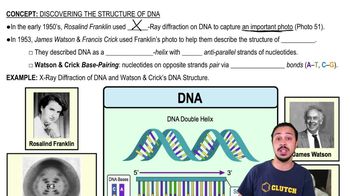
DNA is composed of a backbone made of sugar and phosphate groups, with four nitrogenous bases (adenine, thymine, cytosine, and guanine) attached. The sequence of these bases encodes genetic information, with specific combinations corresponding to different genes. The primary structure refers to the linear sequence of these bases, while the secondary structure describes the double helix formed by base pairing and hydrogen bonding.
Recommended video:
Guided course
04:41
Discovering the Structure of DNA

Base Pairing and Complementarity

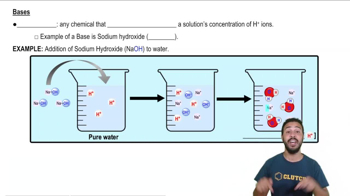
The stability of DNA's secondary structure arises from the specific pairing of bases: adenine pairs with thymine, and cytosine pairs with guanine. This complementarity allows for accurate replication and transcription of genetic information. The predictable pairing ensures that the genetic code can be reliably copied and passed on during cell division, maintaining the integrity of the information.
Recommended video:

Gene Expression and Regulation

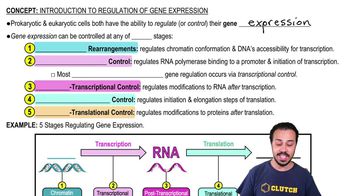
Genes are segments of DNA that contain instructions for synthesizing proteins, which are essential for cellular structure and function. The process of gene expression involves transcription (copying DNA to RNA) and translation (synthesizing proteins from RNA). Regulatory mechanisms control when and how genes are expressed, allowing cells to respond to environmental changes and maintain homeostasis, despite the simplicity of the DNA structure.
Recommended video:
Guided course
06:40
Introduction to Regulation of Gene Expression
Related Practice
Textbook Question
If a base-pair change occurs in DNA, thisa. is a mutation.b. would be a mutation only if it falls in a protein-coding part of a gene.c. would be a mutation only if it falls in a transcribed part of the genome.d. is not a mutation, because only one base pair has been altered.
845
views
Textbook Question

Which of the following is an important exception to the central dogma of molecular biology?

a. Many genes code for RNAs that function directly in the cell.

b. DNA is the repository of genetic information in all cells.

c. Messenger RNA is a short-lived 'information carrier.

d. Proteins are responsible for most aspects of the phenotype.

2510
views
Textbook Question

DNA's primary structure is made up of just four different bases, and its secondary structure is regular and highly stable. How can a molecule with these characteristics hold the information required to build and maintain a cell?

1266
views
Textbook Question

Which of the following describes the experimental strategy that was used to decipher the genetic code?

a. Comparing the amino acid sequences of proteins with the base sequence of their genes

b. Analyzing the sequence of RNAs produced from known DNA sequences

c. Analyzing mutants that changed the code

d. Examining the polypeptides produced when RNAs with particular sequences were translated

837
views
Textbook Question
Which of the following describes the experimental strategy that was used to decipher the genetic code?a. comparing the amino acid sequences of proteins with the base sequence of their genesb. analyzing the sequence of RNAs produced from known DNA sequencesc. analyzing mutants that changed the coded. examining the polypeptides produced when RNAs with particular sequences were translated
1121
views
Textbook Question

A friend says, 'Geneticists spend all their time talking about DNA, but that's silly because DNA really isn't that important in the functions of a cell.' In what ways is she right, and in what ways might she be wrong?

952
views