Draw a chemical equation to represent the redox reaction that occurs when methane (CH4) burns in the presence of oxygen (O2). Identify the reactant that is reduced and the reactant that is oxidized. Of the four molecules that should be in your equation, point out the one that has bonds with the highest potential energy.
Verified step by step guidance
1
Start by writing the chemical equation for the combustion of methane. The reactants are methane (CH₄) and oxygen (O₂), and the products are carbon dioxide (CO₂) and water (H₂O). The balanced equation is: CH₄ + 2O₂ → CO₂ + 2H₂O.
Identify the oxidation and reduction processes. In this reaction, methane (CH₄) is oxidized to carbon dioxide (CO₂), and oxygen (O₂) is reduced to water (H₂O).
Determine which reactant is oxidized. Methane (CH₄) loses electrons as it forms carbon dioxide (CO₂), meaning it is oxidized.
Determine which reactant is reduced. Oxygen (O₂) gains electrons as it forms water (H₂O), meaning it is reduced.
Identify the molecule with the highest potential energy bonds. Methane (CH₄) has C-H bonds, which are high-energy bonds compared to the bonds in the other molecules involved in this reaction.
Verified video answer for a similar problem:
This video solution was recommended by our tutors as helpful for the problem above
Video duration:
4m
Play a video:
Was this helpful?
Key Concepts
Here are the essential concepts you must grasp in order to answer the question correctly.
Redox Reactions
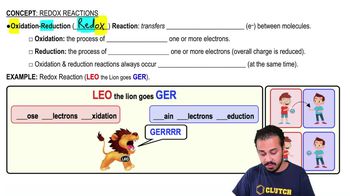
Redox reactions involve the transfer of electrons between two substances. In these reactions, one substance is oxidized (loses electrons) and another is reduced (gains electrons). Understanding which reactant is oxidized and which is reduced is crucial for analyzing the chemical changes occurring in the reaction.
The combustion of methane (CH4) in the presence of oxygen (O2) is a redox reaction where methane is oxidized to carbon dioxide (CO2) and water (H2O) is formed. Methane loses electrons as it forms CO2, while O2 gains electrons to form H2O. This process releases energy, primarily in the form of heat.
Chemical bonds store potential energy, which is released or absorbed during chemical reactions. In the combustion of methane, the C-H bonds in CH4 have higher potential energy compared to the bonds in the products (CO2 and H2O). This energy difference is what drives the reaction and results in the release of energy.