Skip to main content
General Biology
My Course
Learn
Exam Prep
AI Tutor
Study Guides
Textbook Solutions
Flashcards
Explore
Try the app
My Course
Learn
Exam Prep
AI Tutor
Study Guides
Textbook Solutions
Flashcards
Explore
Try the app
Back
Biogeochemical Cycles definitions
You can tap to flip the card.
Biogeochemical Cycle
You can tap to flip the card.
👆
Biogeochemical Cycle
Process recycling chemical nutrients between living and non-living ecosystem components, ensuring element availability.
Track progress
Control buttons has been changed to "navigation" mode.
1/15
Related flashcards
Related practice
Recommended videos
Biogeochemical Cycles quiz #1
Biogeochemical Cycles
1 Term
Biogeochemical Cycles quiz #2
Biogeochemical Cycles
16 Terms
Biogeochemical Cycles quiz #3
Biogeochemical Cycles
20 Terms
Biogeochemical Cycles
52. Ecosystems
4 problems
Topic
Factors Impacting Primary Production
52. Ecosystems
5 problems
Topic
52. Ecosystems - Part 1 of 2
4 topics
10 problems
Chapter
Jason
52. Ecosystems - Part 2 of 2
2 topics
6 problems
Chapter
02:40
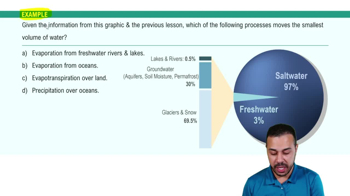
Biogeochemical Cycles Example 2
1809
views
4
rank
04:20
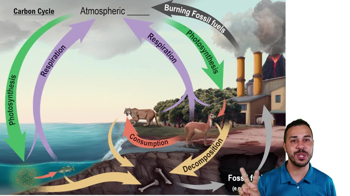
Carbon Cycle
1505
views
9
rank
08:32
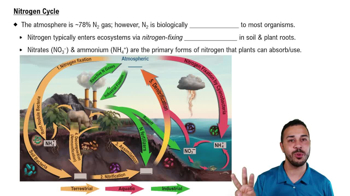
Nitrogen Cycle
1510
views
6
rank
Terms in this set (15)
Hide definitions
Biogeochemical Cycle
Process recycling chemical nutrients between living and non-living ecosystem components, ensuring element availability.
Reservoir
Storage location for chemical elements or nutrients, such as atmosphere, oceans, or rocks, within a cycle.
Water Cycle
Movement of water through evaporation, condensation, precipitation, and runoff, connecting oceans, land, and atmosphere.
Evapotranspiration
Combined process of water loss from soil and plants to the atmosphere, including both evaporation and transpiration.
Aquifer
Underground layer of water-bearing rock or sediment storing groundwater, replenished by percolation.
Carbon Cycle
Pathway of carbon movement through atmosphere, organisms, oceans, and rocks, involving photosynthesis and respiration.
Fossil Fuel
Energy-rich substance formed from ancient organic matter, releasing stored carbon as CO2 when burned.
Greenhouse Gas
Atmospheric gas, such as CO2, that traps heat and contributes to planetary warming.
Nitrogen Cycle
Transformation and movement of nitrogen among atmosphere, organisms, and soil, involving fixation and denitrification.
Nitrogen Fixation
Conversion of atmospheric nitrogen gas into biologically usable forms by bacteria or abiotic processes.
Nitrification
Microbial process converting ammonium into nitrate, making nitrogen accessible to plants.
Denitrification
Microbial conversion of nitrate back into atmospheric nitrogen gas, completing the nitrogen cycle.
Phosphorus Cycle
Movement of phosphorus through rocks, soil, water, and organisms, lacking an atmospheric component.
Sedimentary Rock
Major storage site for phosphorus, formed from compacted mineral and organic particles over time.
Leaching
Process where dissolved nutrients, such as phosphates, are washed from soil into aquatic systems.
 BackBack
 02:40
02:40