How do some plants survive the intense desert heat and drought?
Some plants, like CAM plants, survive intense desert heat and drought by opening their stomata at night to minimize water loss while still allowing for carbon fixation.
What adaptation makes a cactus' role in its specific environment so important for all animals?
Cacti, as CAM plants, have adapted to conserve water by opening their stomata at night, which is crucial for survival in arid environments and provides a water source for animals.
What characteristics allow plants to survive in the desert?
Deep roots, thick cuticles, and CAM photosynthesis.
How do CAM plants avoid water loss?
CAM plants avoid water loss by opening their stomata at night when temperatures are cooler, reducing evaporation.
Desert plants are most likely to have which adaptation?
Desert plants are most likely to have adaptations like CAM photosynthesis, which allows them to open stomata at night to conserve water.
What is one adaptation of conifers that helps them conserve water?
Conifers have needle-like leaves with a thick cuticle that reduces water loss.
Which of these adaptations helps cacti hold on to water? A) Shallow roots B) CAM photosynthesis C) Broad leaves D) High transpiration rate
B) CAM photosynthesis
Which is true about the CAM pathway?
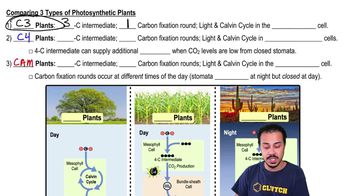
The CAM pathway involves opening stomata at night to fix carbon dioxide, which is stored as a 4-carbon intermediate and used during the day for photosynthesis.
Which answer describes an adaptation used by plants to minimize transpiration?
Plants minimize transpiration by closing stomata during the day and opening them at night, as seen in CAM plants.
On hot days, what will plants do to reduce water loss?
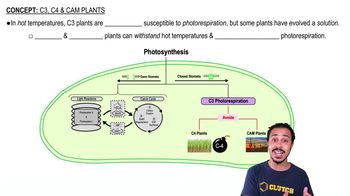
On hot days, plants will close their stomata to reduce water loss through transpiration.
What adaptations in a desert plant prevent water loss?
Adaptations in desert plants that prevent water loss include CAM photosynthesis, thick cuticles, and reduced leaf surface area.
What is a characteristic of C4 leaves?
C4 leaves have specialized anatomy with mesophyll and bundle sheath cells that allow for efficient carbon fixation and reduced photorespiration.
Which characteristic helps grasses survive dry conditions?
Grasses often use the C4 photosynthetic pathway, which allows them to efficiently fix carbon and minimize water loss in dry conditions.
Which plant is an example of a CAM plant?
Cactus
In which type of plant does each photosynthetic cell contain only one chloroplast?
In CAM plants, each photosynthetic cell typically contains only one chloroplast, allowing for efficient carbon fixation at different times.
What is the main difference in carbon fixation between C3, C4, and CAM plants?
C3 plants fix carbon once in the Calvin cycle; C4 and CAM plants fix carbon twice—C4 in two different cells and CAM at two different times.
How do C4 plants minimize photorespiration?
C4 plants minimize photorespiration by fixing CO2 into a 4-carbon intermediate in mesophyll cells, which is then transported to bundle sheath cells for the Calvin cycle, concentrating CO2 and reducing photorespiration.
How do CAM plants adapt to arid environments?
CAM plants open their stomata at night to fix CO2 into a 4-carbon intermediate, storing it for use during the day when stomata are closed, thus conserving water.
How do the timing and location of carbon fixation differ between C4 and CAM plants?
C4 plants separate carbon fixation spatially (in different cells), while CAM plants separate it temporally (at different times—night and day).
Why are most plant species classified as C3 plants?
Most plant species are C3 because they use the standard photosynthetic pathway, which is efficient under moderate conditions.
Give an example of a C4 plant and a CAM plant.
Corn is an example of a C4 plant; cacti are examples of CAM plants.
 Back
Back

 04:34
04:34