Why are C3 plants more susceptible to photorespiration, especially in hot climates?
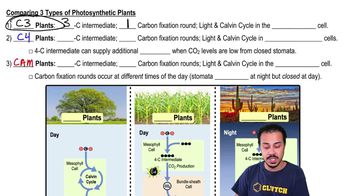
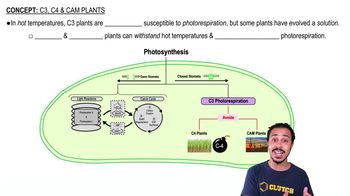
C3 plants are more susceptible because they only fix carbon once in mesophyll cells, and when stomata close in heat, low CO2 leads to increased photorespiration.
In which cell types do the light reactions and Calvin cycle occur in C4 plants?
In C4 plants, light reactions occur in mesophyll cells, while the Calvin cycle occurs in bundle sheath cells.
What is the significance of the 4-carbon intermediate in C4 and CAM plants?
The 4-carbon intermediate acts as a temporary storage of CO2, allowing these plants to maintain photosynthesis when CO2 is scarce due to closed stomata.
What type of environment favors the evolution of CAM photosynthesis?
Arid, hot, and dry environments favor CAM photosynthesis because it helps conserve water.
What is photorespiration and why is it considered inefficient for plants?
Photorespiration is a process where oxygen is fixed instead of CO2, wasting energy and releasing CO2, making photosynthesis less efficient.
How do stomatal behaviors differ between C3, C4, and CAM plants in response to heat?
C3 plants close stomata in heat, increasing photorespiration; C4 plants can keep stomata more open due to efficient CO2 use; CAM plants open stomata at night and close them during the day to conserve water.
Why are C3 plants more susceptible to photorespiration, especially in hot climates?
C3 plants only fix carbon once in mesophyll cells, so when stomata close in heat and CO2 levels drop, photorespiration increases, making them less efficient.
In which cell types do the light reactions and Calvin cycle occur in C4 plants?
In C4 plants, light reactions occur in mesophyll cells, while the Calvin cycle takes place in bundle sheath cells.
What is the significance of the 4-carbon intermediate in C4 and CAM plants?
The 4-carbon intermediate acts as a temporary storage form of CO2, allowing these plants to maintain photosynthesis when CO2 is scarce due to closed stomata.
What type of environment favors the evolution of CAM photosynthesis?
Arid, hot, and dry environments favor CAM photosynthesis because it allows plants to conserve water by opening stomata at night and closing them during the day.
What is a CAM plant and what is a classic example of one?
A CAM plant is a type of plant that fixes carbon dioxide twice, at different times of the day, to minimize water loss and photorespiration. A classic example of a CAM plant is a cactus.
How is a C3 plant best described in terms of photosynthesis?
A C3 plant performs standard photosynthesis with a single round of carbon fixation in the mesophyll cells, producing a three-carbon intermediate during the Calvin cycle. Both the light reactions and the Calvin cycle occur in the same cell.
Which type of plant is best adapted to survive in dry environments, and why?
CAM plants are best adapted to survive in dry environments because they open their stomata at night to fix carbon dioxide, reducing water loss during the hot daytime.
What adaptation helps a plant live in a desert environment?
An adaptation that helps a plant live in a desert is the ability to open stomata at night and close them during the day, as seen in CAM plants, which conserves water and minimizes photorespiration.
Do C4 and CAM plants also use C3 photosynthesis?
Yes, both C4 and CAM plants ultimately use the C3 pathway (Calvin cycle) for the final fixation of carbon dioxide, but they have additional steps to minimize photorespiration.
 Back
Back

 04:34
04:34