Skip to main content
General Biology
My Course
Learn
Exam Prep
AI Tutor
Study Guides
Textbook Solutions
Flashcards
Explore
Try the app
My Course
Learn
Exam Prep
AI Tutor
Study Guides
Textbook Solutions
Flashcards
Explore
Try the app
Back
Carbohydrates quiz #4
You can tap to flip the card.
What is the importance of glycosidic bonds in carbohydrate structure?
You can tap to flip the card.
👆
What is the importance of glycosidic bonds in carbohydrate structure?
Glycosidic bonds determine the structure and function of oligosaccharides and polysaccharides.
Track progress
Control buttons has been changed to "navigation" mode.
1/37
Related flashcards
Related practice
Recommended videos
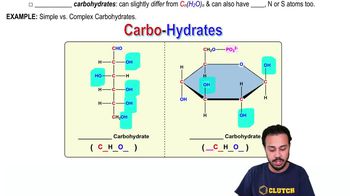
Carbohydrates definitions
Carbohydrates
9 Terms
Carbohydrates quiz #1
Carbohydrates
22 Terms
Carbohydrates exam
Carbohydrates
29 Terms
Carbohydrates
4. Biomolecules
7 problems
Topic
Jason
Proteins
4. Biomolecules
7 problems
Topic
Jason
4. Biomolecules - Part 1 of 2
5 topics
10 problems
Chapter
Jason
4. Biomolecules - Part 2 of 2
4 topics
10 problems
Chapter
Jason
03:08
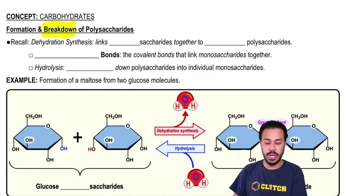
Formation & Breakdown of Polysaccharides
25077
views
420
rank
04:53
Carbohydrates
32635
views
523
rank
1
comments
05:08
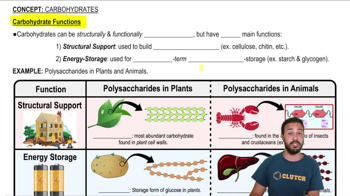
Carbohydrate Functions
24071
views
355
rank
Terms in this set (37)
Hide definitions
What is the importance of glycosidic bonds in carbohydrate structure?
Glycosidic bonds determine the structure and function of oligosaccharides and polysaccharides.
What is the role of carbohydrates in energy storage?
Carbohydrates like starch and glycogen store energy for later use.
What is the role of carbohydrates in structural support?
Carbohydrates like cellulose, chitin, and peptidoglycan provide structural support in various organisms.
What is the significance of dehydration synthesis in carbohydrate formation?
Dehydration synthesis links monosaccharides to form larger carbohydrates, releasing water.
What is the significance of hydrolysis in carbohydrate metabolism?
Hydrolysis breaks down complex carbohydrates into simpler sugars for energy or other uses.
What is the main difference between storage and structural polysaccharides?
Storage polysaccharides store energy, while structural polysaccharides provide support.
What is the function of starch in plants?
Starch stores glucose for energy in plants.
What is the function of glycogen in animals?
Glycogen stores glucose for energy in animals.
What is the function of cellulose in plant cell walls?
Cellulose provides rigidity and structural support to plant cell walls.
What is the function of chitin in animal exoskeletons?
Chitin provides strength and protection in animal exoskeletons.
What is the role of carbohydrates in biological diversity?
Carbohydrates contribute to structural and functional diversity in living organisms.
What is the importance of carbohydrates in living organisms?
Carbohydrates are essential for energy storage, structural support, and cellular communication.
What is the relationship between glucose and starch?
Starch is a polysaccharide made of many glucose units linked together.
What is the relationship between glucose and glycogen?
Glycogen is a polysaccharide made of many glucose units linked together, used for energy storage in animals.
What is the relationship between glucose and cellulose?
Cellulose is a polysaccharide made of glucose units, providing structural support in plants.
What is the relationship between glucose and chitin?
Chitin is a polysaccharide similar to cellulose but with modified glucose units, providing structural support in animals.
What is the significance of the number of monosaccharide units in carbohydrate classification?
The number of monosaccharide units determines whether a carbohydrate is a monosaccharide, oligosaccharide, or polysaccharide.
What is the function of maltose in carbohydrate metabolism?
Maltose is an intermediate disaccharide formed during the breakdown of starch.
What is the importance of the hydroxyl group in carbohydrate solubility?
Hydroxyl groups make carbohydrates soluble in water.
What is the main difference between plant and animal structural polysaccharides?
Plants use cellulose for structure, while animals use chitin.
What is the main difference between plant and animal storage polysaccharides?
Plants store energy as starch, while animals store energy as glycogen.
What is the function of peptidoglycan in bacterial cells?
Peptidoglycan provides structural support and shape to bacterial cell walls.
What is the significance of carbohydrates in cell recognition?
Oligosaccharides on cell surfaces are involved in cell recognition and signaling.
What is the role of carbohydrates in the exoskeleton of insects?
Chitin, a carbohydrate, provides structural support in insect exoskeletons.
What is the role of carbohydrates in the cell wall of bacteria?
Peptidoglycan, a carbohydrate, provides structural support in bacterial cell walls.
What is the significance of glucose as a carbohydrate?
Glucose is the most abundant monosaccharide and a primary energy source.
What is the function of carbohydrates in energy metabolism?
Carbohydrates are broken down to release energy for cellular processes.
What is the importance of glycosidic bonds in polysaccharide structure?
Glycosidic bonds determine the branching and properties of polysaccharides.
What is the function of carbohydrates in plants?
Carbohydrates provide energy storage (starch) and structural support (cellulose) in plants.
What is the function of carbohydrates in animals?
Carbohydrates provide energy storage (glycogen) and structural support (chitin) in animals.
What is the significance of the term 'dehydration synthesis' in carbohydrate chemistry?
Dehydration synthesis is the process by which monosaccharides are joined to form larger carbohydrates, releasing water.
What is the significance of the term 'hydrolysis' in carbohydrate chemistry?
Hydrolysis is the process by which polysaccharides are broken down into monosaccharides by adding water.
Which type of macromolecule is produced by plants during photosynthesis?
Carbohydrates are the type of macromolecule produced by plants during photosynthesis.
What macromolecule is produced during photosynthesis to serve as food for plants?
Carbohydrates are produced during photosynthesis and serve as food for plants.
What type of macromolecule do plants synthesize during photosynthesis?
Plants synthesize carbohydrates during photosynthesis.
What is the function of starch in plants?
Starch functions as an energy storage polysaccharide in plants, storing glucose for later use.
What is the storage form of glucose in plants?
Starch is the storage form of glucose in plants.
 BackBack
 03:08
03:08