 Back
BackCarbon exam

 03:35
03:35
Terms in this set (28)
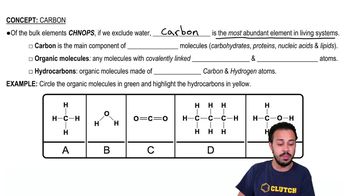
What is the most abundant element in living systems, excluding water?
Carbon
Organic Molecules
Molecules containing covalently linked carbon and hydrogen atoms.
Hydrocarbons
Organic molecules made up solely of carbon and hydrogen atoms.
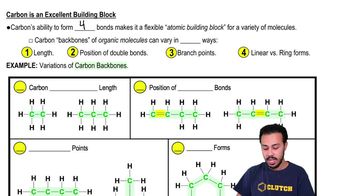
Why is carbon considered an excellent building block for molecules?
Because it can form four covalent bonds, allowing for diverse structures.
What are the four classes of organic molecules?
Carbohydrates, proteins, nucleic acids, and lipids.
What allows carbon to form diverse structures?
Its ability to create four covalent bonds.
What is the main component of organic molecules?
Carbon
What is the difference between organic molecules and hydrocarbons?
Organic molecules contain covalently linked carbon and hydrogen, while hydrocarbons consist solely of these two elements.
What are the four ways carbon backbones can vary?
Length, position of double bonds, branching, and ring formations.
What is a characteristic of hydrocarbons?
They contain only carbon and hydrogen atoms.
What is the significance of carbon in biological processes?
Its versatility allows for the formation of essential macromolecules.
What is an example of a hydrocarbon?
Methane (CH4)
What is the role of carbon in macromolecules?
It forms the backbone of carbohydrates, proteins, nucleic acids, and lipids.
What is the importance of carbon's ability to form four covalent bonds?
It allows for the creation of complex and diverse molecular structures.
What is a common feature of all organic molecules?
They contain covalently linked carbon and hydrogen atoms.
What is the term for molecules that contain only carbon and hydrogen?
Hydrocarbons
What is the significance of the position of double bonds in carbon backbones?
It affects the structure and properties of the molecule.
What is an example of a biomolecule that is not an organic molecule?
Water (H2O)
What is the term for the variation in the length of carbon backbones?
Length variation
What is the term for the variation in the position of double bonds in carbon backbones?
Double bond position variation
What is the term for the variation in the branching of carbon backbones?
Branching variation
What is the term for the variation in the form of carbon backbones?
Ring formation
What is the role of carbon in living systems?
It is the most abundant element and forms the backbone of essential macromolecules.
What is the significance of carbon's versatility?
It is crucial for understanding biological processes and molecular interactions.
What is an example of a molecule that is an organic molecule but not a hydrocarbon?
A molecule with carbon, hydrogen, and oxygen atoms like Carbohydrates.
What is the term for molecules that are not hydrocarbons but are still organic?
Organic molecules with additional elements
What is the significance of carbon backbones in organic molecules?
They provide structural diversity and complexity.
What is the term for the ability of carbon to form different molecular structures?
Structural versatility