Skip to main content
General Biology
My Course
Learn
Exam Prep
AI Tutor
Study Guides
Textbook Solutions
Flashcards
Explore
Try the app
My Course
Learn
Exam Prep
AI Tutor
Study Guides
Textbook Solutions
Flashcards
Explore
Try the app
Back
Chemical Reactions exam
You can tap to flip the card.
Chemical Reaction
You can tap to flip the card.
👆
Chemical Reaction
The process involving the making and breaking of chemical bonds, leading to changes in matter.
Track progress
Control buttons has been changed to "navigation" mode.
1/28
Related flashcards
Related practice
Recommended videos
Chemical Reactions definitions
Chemical Reactions
9 Terms
Chemical Reactions quiz #1
Chemical Reactions
21 Terms
Chemical Reactions
7. Energy and Metabolism
3 problems
Topic
Jason
ATP
7. Energy and Metabolism
3 problems
Topic
Jason
7. Energy and Metabolism
10 topics
13 problems
Chapter
Brendan
01:56
Chemical Reactions
22945
views
387
rank
1
comments
05:48
Types of Chemical Reactions
21210
views
305
rank
1
comments
Terms in this set (28)
Hide definitions
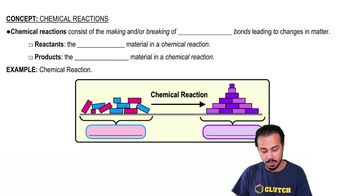
Chemical Reaction
The process involving the making and breaking of chemical bonds, leading to changes in matter.
Reactants
The starting materials in a chemical reaction.
Products
The ending materials in a chemical reaction.
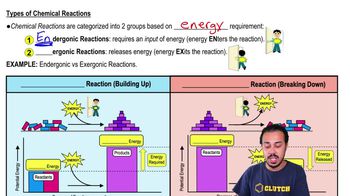
What are endergonic reactions?
Reactions that require an input of energy.
What are exergonic reactions?
Reactions that release energy into the environment.
Endergonic Reaction
A reaction that builds complex molecules and requires energy input.
Exergonic Reaction
A reaction that breaks down complex molecules and releases energy.
What is the role of energy in endergonic reactions?
Energy enters the reaction to build up larger molecules.
What is the role of energy in exergonic reactions?
Energy exits the reaction as molecules are broken down.
Metabolic Pathways
Series of chemical reactions in a cell that build and breakdown molecules for cellular processes.
Energy Dynamics
The study of how energy flows and changes in biological systems.
What happens to energy in an exergonic reaction?
Energy is released into the environment.
What happens to energy in an endergonic reaction?
Energy is absorbed and used to build complex molecules.
Potential Energy
Energy stored in a system due to its position or arrangement.
What is the difference in energy levels between reactants and products in an endergonic reaction?
Products have higher energy than reactants.
What is the difference in energy levels between reactants and products in an exergonic reaction?
Reactants have higher energy than products.
What are the starting materials in a chemical reaction called?
Reactants
What are the ending materials in a chemical reaction called?
Products
What type of reaction builds larger, more complex molecules?
Endergonic Reaction
What type of reaction breaks down larger molecules into smaller components?
Exergonic Reaction
What is required for an endergonic reaction to occur?
An input of energy
What is released during an exergonic reaction?
Energy
What does the 'EX' in exergonic stand for?
Exit, as energy exits the reaction.
What does the 'EN' in endergonic stand for?
Enter, as energy enters the reaction.
What is the significance of understanding chemical reactions in biology?
It is crucial for grasping metabolic pathways and energy dynamics.
What is the energy status of products in an exergonic reaction?
Products have lower energy than reactants.
What is the energy status of products in an endergonic reaction?
Products have higher energy than reactants.
What is the main difference between endergonic and exergonic reactions?
Endergonic reactions require energy input, while exergonic reactions release energy.
 BackBack

 01:56
01:56