Skip to main content
General Biology
My Course
Learn
Exam Prep
AI Tutor
Study Guides
Textbook Solutions
Flashcards
Explore
Try the app
My Course
Learn
Exam Prep
AI Tutor
Study Guides
Textbook Solutions
Flashcards
Explore
Try the app
Back
Circulatory and Respiratory Anatomy exam
1 student found this helpful
You can tap to flip the card.
Gas Exchange
You can tap to flip the card.
👆
Gas Exchange
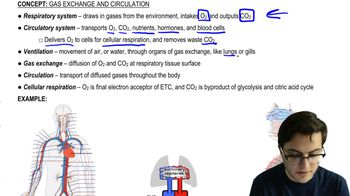
The process where oxygen diffuses into the bloodstream and carbon dioxide diffuses out into the lungs.
Track progress
Control buttons has been changed to "navigation" mode.
1/29
Related flashcards
Related practice
Recommended videos
Circulatory and Respiratory Anatomy quiz #1
Circulatory and Respiratory Anatomy
26 Terms
Circulatory and Respiratory Anatomy definitions
Circulatory and Respiratory Anatomy
10 Terms
Circulatory and Respiratory Anatomy quiz #1
Circulatory and Respiratory Anatomy
34 Terms
Circulatory and Respiratory Anatomy
40. Circulatory System
7 problems
Topic
Jason
Heart Physiology
40. Circulatory System
7 problems
Topic
Jason
40. Circulatory System
3 topics
9 problems
Chapter
Jason
02:15
Lymphatic System
3274
views
14
rank
06:24
Lung Anatomy
3038
views
11
rank
06:28
Gas Exchange and Circulation
4982
views
60
rank
Terms in this set (29)
Hide definitions
Gas Exchange
The process where oxygen diffuses into the bloodstream and carbon dioxide diffuses out into the lungs.
What is the primary function of the respiratory system?
To bring in oxygen and expel carbon dioxide.
Arteries
Blood vessels that carry blood away from the heart.
What is the role of veins in the circulatory system?
To transport blood back to the heart.
Alveoli
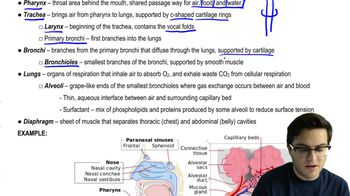
Tiny sacs in the lungs where gas exchange occurs.
What is the function of the diaphragm?
To contract and create negative pressure, pulling air into the lungs.
Pulmonary Circulation
The loop of circulation that carries deoxygenated blood from the heart to the lungs and returns oxygenated blood back to the heart.
What is systemic circulation?
The loop of circulation that delivers oxygenated blood to the body and returns deoxygenated blood to the heart.
Capillaries
Small blood vessels where gas and nutrient exchange occurs between blood and tissues.
What are the main components of blood?
Plasma, white blood cells, and red blood cells.
Hemoglobin
A protein in red blood cells that carries oxygen.
What is the function of white blood cells?
To help fight and identify infections.
Pharynx
The shared passageway for food, air, and water at the back of the mouth.
What is the trachea?
The windpipe that brings air from the pharynx to the lungs.
Bronchi
The two main branches of the trachea that lead into the lungs.
What are bronchioles?
The smallest branches of the bronchi, supported by smooth muscle.
Surfactant
A substance that reduces surface tension in the alveoli, preventing them from collapsing.
What is the role of the lymphatic system?
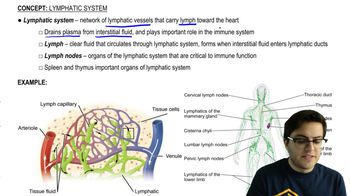
To drain excess plasma from interstitial fluid and return it to the bloodstream.
Atria
The chambers of the heart that receive blood from veins.
What are ventricles?
The chambers of the heart that receive blood from atria and pump it into arteries.
Atrioventricular Valves
Valves that prevent backflow from the ventricles to the atria.
What is the function of semilunar valves?
To prevent backflow from the ventricles to the arteries.
Pulmonary Artery
The artery that carries deoxygenated blood from the heart to the lungs.
What is the aorta?
The main artery that delivers oxygenated blood from the heart to the body.
Vena Cava
The large veins that return deoxygenated blood from the body to the heart.
What is erythropoietin?
A hormone secreted by the kidney that stimulates red blood cell production.
Sickle Cell Disease
A disease caused by abnormal hemoglobin that results in distorted red blood cells.
What is the role of platelets?
To play an important role in blood clotting.
Endothelium
The special type of epithelial tissue that lines the interior surface of blood vessels.
 BackBack
 02:15
02:15