Skip to main content
General Biology
My Course
Learn
Exam Prep
AI Tutor
Study Guides
Textbook Solutions
Flashcards
Explore
Try the app
My Course
Learn
Exam Prep
AI Tutor
Study Guides
Textbook Solutions
Flashcards
Explore
Try the app
Back
Cladistics definitions
You can tap to flip the card.
Cladistics
You can tap to flip the card.
👆
Cladistics
Classification method focusing on grouping organisms by shared ancestry as depicted on a phylogenetic tree.
Track progress
Control buttons has been changed to "navigation" mode.
1/14
Related flashcards
Related practice
Recommended videos
Cladistics quiz #2
Cladistics
11 Terms
Cladistics quiz #3
Cladistics
10 Terms
Cladistics
25. Phylogeny
4 problems
Topic
Phylogenetics and Genome Evolution
25. Phylogeny
4 problems
Topic
25. Phylogeny - Part 1 of 2
4 topics
10 problems
Chapter
Jason
25. Phylogeny - Part 2 of 2
1 topic
2 problems
Chapter
Guided course
03:52
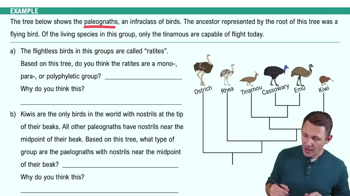
Cladistics Example 1
2235
views
18
rank
Guided course
06:37
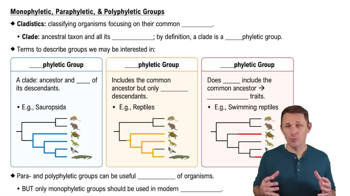
Monophyletic, Paraphyletic, & Polyphyletic Group
3108
views
19
rank
Terms in this set (14)
Hide definitions
Cladistics
Classification method focusing on grouping organisms by shared ancestry as depicted on a phylogenetic tree.
Phylogenetic Tree
Diagram illustrating evolutionary relationships among organisms, showing common ancestry and divergence.
Monophyletic Group
Set including an ancestor and all its descendants, forming a single complete branch on a phylogenetic tree.
Clade
Branch on a phylogenetic tree representing an ancestor and all its descendants; equivalent to a monophyletic group.
Paraphyletic Group
Set including an ancestor and some, but not all, of its descendants, leaving out at least one lineage.
Polyphyletic Group
Set composed of organisms lacking their most recent common ancestor, often grouped by analogous traits.
Systematics
Scientific discipline concerned with naming and classifying organisms based on evolutionary relationships.
Analogous Trait
Characteristic shared by different groups due to convergent evolution, not inherited from a common ancestor.
Common Ancestor
Organism from which multiple lineages descend, serving as a reference point for group classification.
Sauropsida
Monophyletic group including turtles, lizards, birds, and crocodiles, united by descent from a shared ancestor.
Reptiles
Paraphyletic group traditionally including turtles, lizards, and crocodiles, but excluding birds.
Descendant
Organism or group arising from a specific ancestor, forming part of a lineage on a phylogenetic tree.
Branch
Line on a phylogenetic tree representing evolutionary divergence from a common ancestor.
Taxon
Named group of organisms at any rank, such as species, genus, or family, used in classification.
 BackBack
 03:52
03:52