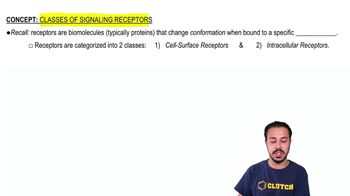
Receptor proteins change conformation when bound to a specific ligand or signaling molecule, initiating a cellular response.
Most cell receptors are what type of molecules?
Most cell receptors are proteins.
What are the two main classes of signaling receptors?
The two main classes of signaling receptors are cell surface receptors and intracellular receptors.
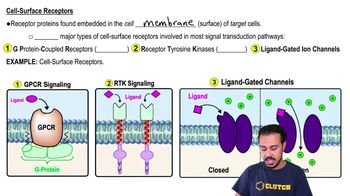
Where are cell surface receptors located?
Cell surface receptors are embedded in the cell membrane.
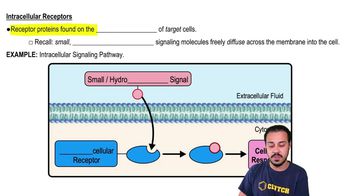
What type of molecules do intracellular receptors interact with?
Intracellular receptors interact with small hydrophobic signaling molecules.
How do ligand-gated ion channels function?
Ligand-gated ion channels open to allow ions to flow through the membrane when a ligand binds to them.
What is the role of G protein-coupled receptors (GPCRs)?
GPCRs are a type of cell surface receptor that change conformation upon ligand binding to initiate a signaling cascade.
What happens when a small hydrophobic molecule binds to an intracellular receptor?
It triggers a cascade of events leading to a cellular response.
What distinguishes receptor tyrosine kinases (RTKs) from other cell surface receptors?
RTKs have two domains and initiate signaling pathways through phosphorylation upon ligand binding.
What are the two main classes of signaling receptors in cells, and where are they located?
The two main classes of signaling receptors are cell surface receptors, which are embedded in the cell membrane, and intracellular receptors, which are located inside the cell.
How do intracellular receptors differ from cell surface receptors in terms of the signaling molecules they interact with?
Intracellular receptors interact with small, hydrophobic signaling molecules that can diffuse across the cell membrane, whereas cell surface receptors bind to signaling molecules that cannot cross the membrane and must interact from outside the cell.
 Back
Back
 00:52
00:52