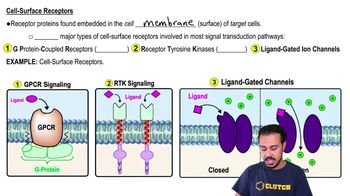
Name and briefly describe the three major types of cell surface receptors.
The three major types of cell surface receptors are: G protein-coupled receptors (GPCRs), which interact with G proteins to transmit signals; receptor tyrosine kinases (RTKs), which have enzymatic activity and phosphorylate tyrosine residues; and ligand-gated ion channels, which open or close in response to ligand binding to allow ions to pass through the membrane.
Why is it important to understand the classes of signaling receptors in the study of signal transduction pathways?
Understanding the classes of signaling receptors is important because they determine how signals are received and processed by cells, which is essential for comprehending cellular communication and the mechanisms underlying signal transduction pathways.
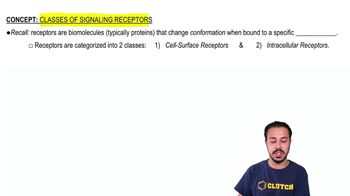
What are the two main classes of signaling receptors in cells?
The two main classes are cell surface receptors, which are embedded in the cell membrane, and intracellular receptors, which are found inside the cell.
Where are cell surface receptors located and what is their general function?
Cell surface receptors are embedded in the cell membrane and function to receive and transmit signals from extracellular ligands into the cell.
Name the three major types of cell surface receptors.
The three major types are G protein-coupled receptors (GPCRs), receptor tyrosine kinases (RTKs), and ligand-gated ion channels.
How do ligand-gated ion channels function upon ligand binding?
Ligand-gated ion channels change conformation to open or close, allowing ions to pass through the membrane when a ligand binds.
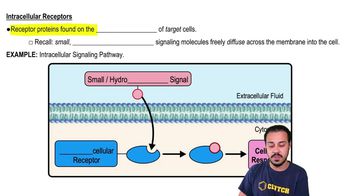
What is the primary characteristic of molecules that interact with intracellular receptors?
They are typically small and hydrophobic, allowing them to freely diffuse across the cell membrane.
Where are intracellular receptors found and what triggers their activation?
Intracellular receptors are found inside the cell, and they are activated when small hydrophobic signaling molecules bind to them.
Why is it important to understand the classes of signaling receptors in biology?
Understanding these classes is essential for comprehending how cells receive and process signals, which underlies cellular communication and signal transduction pathways.
What unique feature distinguishes receptor tyrosine kinases (RTKs) from other cell surface receptors?
RTKs have enzymatic activity and can phosphorylate tyrosine residues on themselves or other proteins upon ligand binding.