Community Interactions: Exploitation (+/-) exam Flashcards

Community Interactions: Exploitation (+/-) exam
Control buttons has been changed to "navigation" mode.
1/29
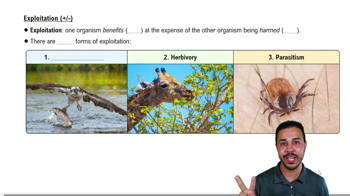
  • Exploitation
    An interaction where one organism benefits at the expense of another.
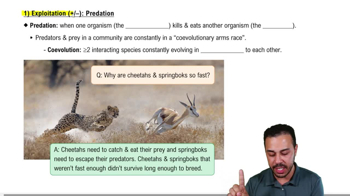
  • Predation
    When a predator kills and consumes prey.
  • Herbivory
    When an herbivore consumes plants, algae, or photosynthetic bacteria.
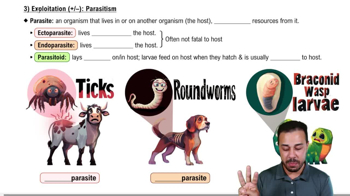
  • Parasitism
    An interaction where a parasite lives on or in a host, taking resources from it.
  • Coevolution
    When two or more interacting species evolve in response to each other.
  • Echolocation
    A method used by bats to navigate and hunt using high-frequency sound waves.
  • Aposematic coloration
    Bright warning colors used by prey to signal unpalatability to predators.
  • Batesian mimicry
    A harmless species mimics a harmful one to deter predators.
  • Mullerian mimicry
    Two or more harmful species share similar warning coloration.
  • Ectoparasite
    A parasite that lives outside the host.
  • Endoparasite
    A parasite that lives inside the host.
  • Parasitoid
    An organism that lays eggs on or in a host, leading to the host's death.
  • What is the main benefit of echolocation for bats?
    It allows bats to navigate and hunt in complete darkness.
  • What is the primary defense mechanism of the Indian pangolin?
    A hard outer shell that protects it from predators.
  • What is caudalautonomy?
    The ability of some animals, like the wall gecko, to self-amputate their tail to escape predators.
  • What is the main difference between ectoparasites and endoparasites?
    Ectoparasites live outside the host, while endoparasites live inside the host.
  • What is the role of thorns in plants?
    Thorns act as a physical defense to deter herbivores.
  • What is the relationship between cheetahs and springboks an example of?
    A coevolutionary arms race.
  • What adaptation helps the Indonesian pit viper hunt in darkness?
    Heat sensing abilities.
  • What is the main characteristic of Mullerian mimicry?
    Mutual benefits for all species involved.
  • What is the primary function of aposematic coloration?
    To warn predators that the prey is unpalatable.
  • What is the main difference between Batesian and Mullerian mimicry?
    Batesian mimicry involves a harmless species mimicking a harmful one, while Mullerian mimicry involves multiple harmful species sharing similar warning signals.
  • What is the primary benefit of living in a group for prey animals?
    Increased protection from predators.
  • What is the main consequence of parasitism for the host?
    The host loses resources to the parasite.
  • What is the primary adaptation of herbivores to consume plants?
    Specialized digestive systems or teeth.
  • What is the main outcome of a parasitoid's life cycle for the host?
    The host typically dies.
  • What is mimicry in ecological interactions?
    When one species imitates another species or object for survival benefits.
  • What is the primary defense mechanism of the common wall gecko?
    Cryptic coloration or camouflage.
  • What is the main purpose of toxins in plants?
    To deter herbivores from consuming them.