 Back
BackCovalent Bonds exam


 04:28
04:28
Terms in this set (29)
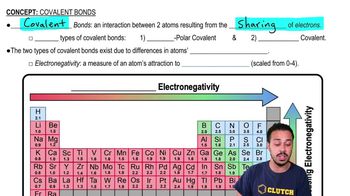
Covalent Bond
An interaction between two atoms that results from the sharing of electrons.
What does the term 'covalent' mean?
Sharing of electrons.
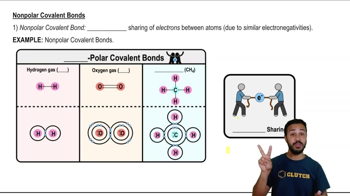
Nonpolar Covalent Bond
A type of covalent bond where electrons are shared equally between atoms.
Why do nonpolar covalent bonds share electrons equally?
Because the atoms involved have similar or equal electronegativities.
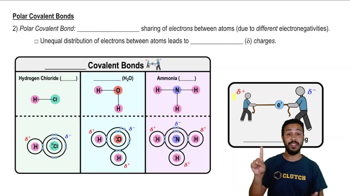
Polar Covalent Bond
A type of covalent bond where electrons are shared unequally between atoms.
What causes the unequal sharing of electrons in polar covalent bonds?
Different electronegativities of the atoms involved.
Electronegativity
A measure of an atom's attraction to electrons.
How is electronegativity scaled?
From 0 to 4, with higher values indicating stronger attraction to electrons.
What is the most electronegative element?
Fluorine.
Partial Charge
A fractioned charge resulting from unequal sharing of electrons in polar covalent bonds.
What symbol represents a partial charge?
The Greek symbol delta (δ).
Example of a Nonpolar Covalent Bond
Hydrogen gas (H2), where two hydrogen atoms share electrons equally.
Example of a Polar Covalent Bond
Water (H2O), where oxygen has a partial negative charge and hydrogen has partial positive charges.
Why does oxygen in water have a partial negative charge?
Because oxygen is highly electronegative and pulls electrons more strongly.
What happens to the hydrogen atoms in water due to oxygen's high electronegativity?
They acquire partial positive charges.
Periodic Table Trend for Electronegativity
Electronegativity increases from left to right and from bottom to top.
Why is it important to understand covalent bonds?
To grasp molecular interactions and properties in chemistry.
What is the chemical formula for methane?
CH4.
Why are the bonds in methane considered nonpolar?
Because carbon and hydrogen have similar electronegativities.
What is the chemical formula for ammonia?
NH3.
Why does nitrogen in ammonia have a partial negative charge?
Because nitrogen is more electronegative than hydrogen and pulls electrons more strongly.
What is the result of unequal sharing of electrons in polar covalent bonds?
Partial charges on the atoms involved.
What is the chemical formula for hydrogen chloride?
HCl.
Why does chloride in HCl have a partial negative charge?
Because chloride is more electronegative than hydrogen and pulls electrons more strongly.
What is the significance of electronegativity in covalent bonds?
It determines whether the bond will be nonpolar or polar.
What does a line between two atoms in a molecule represent?
A covalent bond.
How are electrons shared in a nonpolar covalent bond?
Equally.
How are electrons shared in a polar covalent bond?
Unequally.
What is the chemical formula for oxygen gas?
O2.