Skip to main content
General Biology
My Course
Learn
Exam Prep
AI Tutor
Study Guides
Textbook Solutions
Flashcards
Explore
Try the app
My Course
Learn
Exam Prep
AI Tutor
Study Guides
Textbook Solutions
Flashcards
Explore
Try the app
Back
Developmental Biology exam
You can tap to flip the card.
Cell Division
You can tap to flip the card.
👆
Cell Division
The process by which a single cell divides to form two new cells, crucial for development.
Track progress
Control buttons has been changed to "navigation" mode.
1/29
Related flashcards
Related practice
Recommended videos
Developmental Biology definitions
Developmental Biology
56 Terms
Developmental Biology quiz #1
Developmental Biology
27 Terms
Developmental Biology quiz #2
Developmental Biology
32 Terms
Developmental Biology
20. Development
7 problems
Topic
Jason
Animal Development
20. Development
7 problems
Topic
Jason
20. Development
3 topics
7 problems
Chapter
Jason
12:48
Differential Expression, Morphogens, and Pattern Formation
3830
views
8
rank
1
comments
03:45
Body Axes
3041
views
8
rank
05:28
Cell Division and Differentiation
4726
views
17
rank
2
comments
Terms in this set (29)
Hide definitions
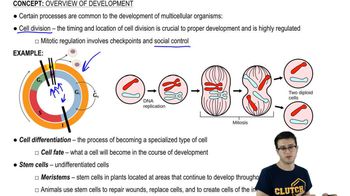
Cell Division
The process by which a single cell divides to form two new cells, crucial for development.
What is the role of mitotic control in development?
Mitotic control regulates the timing and location of cell division, ensuring proper development.
Cell Differentiation
The process by which an undifferentiated cell becomes specialized, such as a neuron or epithelial cell.
What are meristems?
Regions in plants where stem cells are located and continue to develop throughout the plant's life.
Social Control
Mechanisms by which neighboring cells influence each other's division and behavior.
What is cell fate?
The destiny of a cell, determined by differentiation, to become a specific cell type.
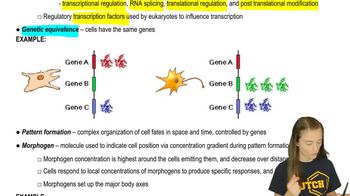
Differential Gene Expression
The process by which cells with the same genetic makeup express different genes, leading to diverse cell types.
How do morphogens influence development?
Morphogens establish body axes and patterns by creating concentration gradients that guide cell behavior.
Hox Genes
A subset of homeotic genes that control the development of specific anatomical structures.
What is apoptosis?
A type of programmed cell death important for development, such as the separation of digits.
Transcriptional Regulation
The control of which genes are transcribed into mRNA in a cell.
What is translational regulation?
The control of which mRNA is translated into proteins, affecting cell phenotype.
Post-Translational Modification
Changes made to proteins after translation to enable specific functions in cells.
What is pattern formation?
The complex organization of different cell fates in the body over space and time, controlled by genes.
Morphogenesis
The process of developing the body and its patterns, guided by morphogens.
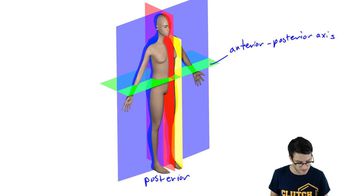
What are the anterior and posterior axes?
The anterior axis is toward the head, and the posterior axis is toward the tail or bum.
Dorsal-Ventral Axis
The axis that runs from the back (dorsal) to the belly (ventral) of an organism.
What are toolkit genes?
A small subset of genes that control an organism's development.
Homeotic Genes
Genes that control the development of specific anatomical structures.
How are Hox genes related to evolution?
Hox genes are highly conserved and have been passed down through evolution, controlling development across species.
What is the role of chemical signals in development?
Chemical signals fine-tune development by regulating gene expression and cell behavior.
Gap Genes
Genes that help refine the major body axes during early development.
What are pair-rule genes?
Genes that further refine the body plan by dividing the embryo into segments.
Segment Polarity Genes
Genes that define the anterior and posterior ends of each segment in the developing embryo.
Effector Genes
Genes that produce the final structures and functions in the developing organism.
What is the significance of conserved developmental processes?
Conserved processes indicate that many developmental mechanisms are shared across different species, linking development to evolution.
How do cells know their position in the body?
Cells use morphogens and their concentration gradients to determine their position and role in the body.
What is the role of transcription factors?
Transcription factors influence which genes are turned on or off in a cell, affecting its function and phenotype.
How do animals and plants differ in cell movement during development?
Animal cells move to form structures, while plant cells expand and change shape to achieve similar results.
 BackBack
 12:48
12:48