What is the main difference between weather and climate?
Weather refers to short-term atmospheric conditions over hours or days, while climate is the long-term average of weather patterns over years or decades.
How does the angle of sunlight affect global climate?
Regions where sunlight hits at a higher angle (closer to 90 degrees) receive more energy and are warmer, while lower angles spread energy over a larger area, resulting in cooler climates.
Why are regions near the equator generally warmer than those near the poles?
The equator receives more direct sunlight year-round, concentrating heat in a smaller area, while the poles receive sunlight at lower angles, spreading energy over a larger area and making them colder.
What is the significance of Earth's 23.5-degree axial tilt?
The tilt causes seasonal changes by varying the angle and intensity of sunlight received in different regions throughout the year.
How do seasons in the northern and southern hemispheres relate to each other?
They are opposite; when it is summer in the northern hemisphere, it is winter in the southern hemisphere, and vice versa.
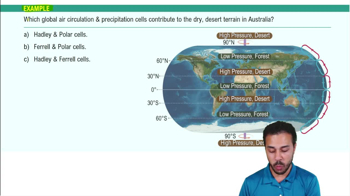
What is the Hadley cell and what climate pattern does it create?
The Hadley cell is a large-scale air circulation pattern from the equator to 30 degrees latitude, creating rainforests at the equator and deserts at 30 degrees latitude.
How does surface air pressure differ at the equator compared to 30 degrees latitude, and what is the result?
The equator has low surface air pressure, promoting rain and forests, while 30 degrees latitude has high pressure, inhibiting rain and creating deserts.
What is the Coriolis effect and how does it influence prevailing winds?
The Coriolis effect is caused by Earth's rotation and curves the paths of moving objects, causing prevailing winds to be deflected eastward or westward depending on their direction.
How do prevailing winds differ when moving toward the equator versus toward the poles?
Winds moving toward the equator are deflected westward, while winds moving toward the poles are deflected eastward due to the Coriolis effect.
How do ocean gyres affect global climate?
Ocean gyres transfer heat from the equator toward the poles and return cooler water to the equator, helping to balance global temperatures.
Why do coastal regions tend to have more stable temperatures than inland regions?
Water has a high specific heat, so it heats and cools more slowly than land, stabilizing the climate of nearby coastal areas.
How does water help regulate atmospheric carbon dioxide levels?
Water absorbs and sequesters carbon dioxide, reducing the greenhouse effect, but this can also lead to ocean acidification, affecting aquatic life.
What is a rain shadow and how is it formed?
A rain shadow is a dry area on the leeward side of a mountain, formed when moist air rises, cools, and loses moisture on the windward side, leaving dry air to descend on the other side.
How do forests contribute to cooling the climate?
Forests cool the climate through photosynthesis, which removes CO2, and transpiration, which releases water vapor that forms clouds and precipitation.
What is the relationship between deforestation and local climate?
Deforestation reduces the cooling effects of photosynthesis and transpiration, leading to higher temperatures and less cloud cover in the affected area.
 Back
Back
 01:36
01:36