Biotic factors are the living components of the environment, such as plants, animals, bacteria, and other organisms that influence an organism.
How can past biotic and abiotic factors influence present-day ecological interactions?
Past biotic and abiotic factors, such as extinct species or historical geological events, can shape the evolution and current interactions of organisms.
What is a habitat?
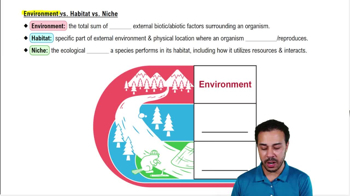
A habitat is the specific physical location where an organism lives and reproduces, meeting its basic needs for survival.
At what levels can ecology be studied?
Ecology can be studied at the organismal, population, community, ecosystem, landscape/seascape, and global levels.
What is population ecology?
Population ecology studies the dynamics of populations of a single species, including changes in size, birth rates, and death rates.
What is ecosystem ecology?
Ecosystem ecology investigates the flow of energy and nutrients and the interactions between living (biotic) and nonliving (abiotic) components in an ecosystem.
What is seascape ecology?
Seascape ecology examines the spatial arrangement and interactions among multiple aquatic ecosystems.
How do biotic factors of the present affect polar bears?
Present-day biotic factors, such as the distribution of seals (their main prey), influence where polar bears are found.
How can extinct species influence current ecological interactions?
Extinct species, such as woolly mammoths, influenced the evolution of current species, affecting their present-day interactions.
What is the environment of an organism?
The environment is the sum of all external biotic and abiotic factors that surround and influence an organism.
What is an example of a question studied in organismal ecology?
An example is: What is the diet of a capybara in a specific region?
What is an example of a question studied in community ecology?
An example is: How do caiman predators affect the distribution of capybaras in a wetland ecosystem?
What is an example of a question studied in landscape ecology?
An example is: How do forest and mountain ecosystems affect capybaras and nearby wetland ecosystems?
Why is understanding ecological levels important?
Understanding ecological levels helps scientists analyze interactions from individuals to the entire biosphere, aiding in biodiversity and conservation efforts.
What is the biosphere?
The biosphere is the global sum of all ecosystems, encompassing all life and their environments on Earth.
What is the main focus of ecosystem ecology?
Ecosystem ecology focuses on energy flow, nutrient cycling, and interactions between living and nonliving components.
Why is the study of past ecological factors important?
Studying past ecological factors helps explain current species distributions, adaptations, and ecosystem structures.
How does an organism's niche include both biotic and abiotic interactions?
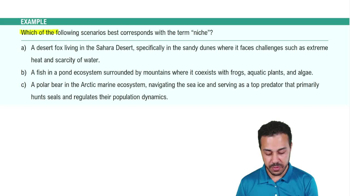
An organism's niche encompasses how it uses resources, interacts with other species, and tolerates environmental conditions.
How do community interactions influence ecosystem structure?
Community interactions, such as predation and competition, shape species composition and ecosystem stability.
How do ecologists define a community?
A community is defined as multiple populations of different species living in the same area at the same time.
How can ecological studies contribute to biodiversity conservation?
Ecological studies identify key interactions and threats, guiding conservation strategies to protect species and ecosystems.
How do abiotic factors like climate influence global ecology?
Abiotic factors such as climate affect the distribution, abundance, and interactions of species on a global scale.
How does the study of ecology help us understand environmental issues?
Ecology provides insights into how human activities impact ecosystems, guiding solutions for environmental problems.
How do ecologists use the concept of the environment?
Ecologists use the environment concept to study all factors influencing an organism, both living and nonliving.
How do energy and nutrient cycles relate to ecosystem ecology?
Ecosystem ecology examines how energy and nutrients move through living and nonliving components, sustaining life.
How do biotic interactions shape community structure?
Biotic interactions like predation, competition, and symbiosis determine which species coexist and their relative abundances.
How does the concept of landscape ecology help in conservation planning?
Landscape ecology helps identify how different ecosystems interact, guiding the design of protected areas and corridors.
How do ecologists define an ecosystem?
An ecosystem is a community of living organisms and their nonliving environment interacting as a system.
How do organisms adapt to their environment?
Organisms adapt through behavioral, physiological, and evolutionary changes that improve their survival and reproduction.
How do ecologists study population changes over time?
Ecologists monitor birth rates, death rates, immigration, and emigration to analyze population size and trends.
What is the significance of the term 'biosphere' in ecology?
The biosphere represents the global ecological system integrating all living beings and their relationships with the environment.
How do abiotic factors influence the distribution of species?
Abiotic factors like temperature, water, and soil type limit where species can live and reproduce.
What is the main focus of community ecology?
Community ecology focuses on the interactions between different species living in the same area.
How does the study of ecology contribute to understanding climate change impacts?
Ecology helps predict how climate change affects species distributions, ecosystem functions, and biodiversity.
What is the difference between landscape and ecosystem ecology?
Ecosystem ecology studies interactions within a single ecosystem, while landscape ecology examines interactions among multiple ecosystems.
How do biotic and abiotic factors together determine an organism's survival?
Both biotic and abiotic factors provide resources and conditions necessary for survival, influencing where organisms can live.
Why is the study of ecological niches important?
Studying niches helps explain species diversity, resource partitioning, and ecosystem stability.
How do ecologists define a population?
A population is a group of individuals of the same species living in the same area at the same time.
What is the role of energy flow in maintaining ecosystem health?
Energy flow supports all life processes and maintains the structure and function of ecosystems.
How do past abiotic events, like continental drift, affect present-day species?
Past abiotic events can alter species distributions, isolate populations, and drive evolutionary changes.
 Back
Back

 05:01
05:01