 Back
BackEndocytosis and Exocytosis exam


 01:52
01:52
Terms in this set (27)
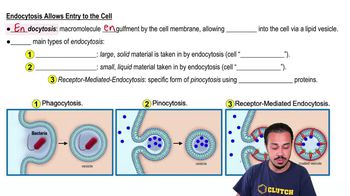
Endocytosis
The process of engulfing macromolecules via lipid vesicles to enter the cell.
What are the three main types of endocytosis?
Phagocytosis, pinocytosis, and receptor-mediated endocytosis.
Phagocytosis
A type of endocytosis where large solid materials are taken into the cell, also known as cell eating.
Pinocytosis
A type of endocytosis where small liquid materials are taken into the cell, also known as cell drinking.
Receptor-mediated endocytosis
A specific form of pinocytosis that uses receptor proteins to bring molecules into the cell.
Exocytosis
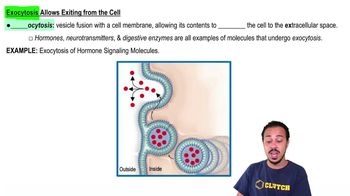
The process of vesicle fusion with the plasma membrane to release contents into the extracellular space.
What types of molecules can undergo exocytosis?
Hormones, neurotransmitters, and digestive enzymes.
What is the role of vesicles in endocytosis?
Vesicles transport large macromolecules into the cell by engulfing them.
What is the role of vesicles in exocytosis?
Vesicles fuse with the plasma membrane to release their contents outside the cell.
What does the 'en' in endocytosis remind you of?
Engulfment and entry into the cell.
What does the 'ex' in exocytosis remind you of?
Exit from the cell and extracellular space.
How do large biomolecules cross the cell membrane?
Through endocytosis and exocytosis.
What is the difference between phagocytosis and pinocytosis?
Phagocytosis involves solid materials (cell eating), while pinocytosis involves liquid materials (cell drinking).
What is the function of receptor proteins in receptor-mediated endocytosis?
They specifically bind to molecules to facilitate their entry into the cell.
What happens to the vesicle contents during exocytosis?
They are released into the extracellular space.
What is the significance of endocytosis and exocytosis in cellular transport?
They are crucial for transporting large biomolecules across cell membranes.
What is a lipid vesicle?
A small membrane-bound bubble that transports molecules within cells.
How does receptor-mediated endocytosis differ from regular pinocytosis?
It uses specific receptor proteins to bind and bring in molecules.
What is the main purpose of exocytosis?
To expel molecules from the cell into the extracellular space.
What is the main purpose of endocytosis?
To bring large molecules into the cell.
What is the role of the plasma membrane in exocytosis?
It fuses with vesicles to release their contents outside the cell.
What is the role of the plasma membrane in endocytosis?
It engulfs macromolecules to form vesicles that enter the cell.
What is cellular drinking?
Pinocytosis, where the cell takes in liquid materials.
What is cellular eating?
Phagocytosis, where the cell takes in solid materials.
What is the significance of receptor proteins in cellular transport?
They facilitate the specific uptake of molecules during receptor-mediated endocytosis.
What is the main difference between endocytosis and exocytosis?
Endocytosis brings molecules into the cell, while exocytosis expels them out.
What is the function of vesicles in cellular transport?
They transport large molecules across the cell membrane during endocytosis and exocytosis.