 Back
BackEnzyme Inhibition exam


 05:03
05:03
Terms in this set (28)
Enzyme Inhibition
The process of slowing down or stopping the activity of an enzyme.
What are the two main types of enzyme inhibitors?
Competitive and noncompetitive inhibitors.
Competitive Inhibitors
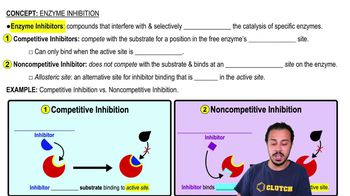
Inhibitors that bind to the active site of an enzyme, blocking substrate access.
Noncompetitive Inhibitors
Inhibitors that bind to an allosteric site, altering the enzyme's shape and preventing substrate binding.
Active Site
The region on an enzyme where the substrate binds.
Allosteric Site
An alternative site on an enzyme where noncompetitive inhibitors bind.
How do competitive inhibitors affect enzyme activity?
They compete with the substrate for the active site, preventing substrate binding and slowing down the reaction.
How do noncompetitive inhibitors affect enzyme activity?
They bind to an allosteric site, causing a change in enzyme shape that prevents substrate binding.
Catalysis
The acceleration of a chemical reaction by a catalyst, such as an enzyme.
What happens when a competitive inhibitor binds to an enzyme?
It blocks the substrate from binding to the active site, inhibiting the enzyme's activity.
What happens when a noncompetitive inhibitor binds to an enzyme?
It changes the shape of the enzyme, including the active site, preventing substrate binding.
Metabolic Balance
The equilibrium between different metabolic pathways in a cell.
Why is enzyme inhibition important?
It helps regulate the speed of chemical reactions in cells, maintaining metabolic balance.
Drug Design
The process of designing new medications based on the knowledge of biological targets.
How can enzyme inhibitors be used in medicine?
They can be used to design drugs that regulate enzyme activity in various diseases.
Substrate
The molecule upon which an enzyme acts.
What is the role of the active site in enzyme function?
It is the specific region where the substrate binds and the reaction occurs.
What is the effect of a noncompetitive inhibitor on the active site?
It alters the shape of the active site, preventing substrate binding.
Enzyme
A protein that catalyzes chemical reactions in living organisms.
What is the difference between competitive and noncompetitive inhibition?
Competitive inhibition involves binding to the active site, while noncompetitive inhibition involves binding to an allosteric site.
What is the purpose of enzyme inhibition in cells?
To regulate the speed of chemical reactions and maintain metabolic balance.
How do competitive inhibitors and substrates interact?
They compete for the same binding site on the enzyme.
How do noncompetitive inhibitors and substrates interact?
Noncompetitive inhibitors bind to a different site, not competing directly with the substrate.
What is the result of enzyme inhibition on catalysis?
It slows down or stops the catalysis of the enzyme.
What is the significance of the allosteric site in enzyme inhibition?
It allows noncompetitive inhibitors to bind and alter enzyme activity without competing with the substrate.
What is the main function of enzymes in cells?
To speed up chemical reactions.
How does enzyme inhibition relate to drug design?
Inhibitors can be used to create drugs that target specific enzymes involved in diseases.
What is the impact of enzyme inhibition on metabolic pathways?
It helps control the flow and balance of metabolic reactions.