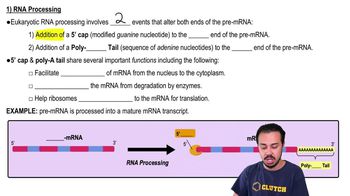
The poly-A tail protects mRNA from degradation and aids in export from the nucleus.
What is the function of the spliceosome?
The spliceosome removes introns and joins exons to form mature mRNA.
Which of these statements correctly describes RNA processing in eukaryotic cells?
RNA processing involves adding a 5' cap, a poly-A tail, and removing introns to form mature mRNA.
What is not a function of the 3' poly-A tail in mRNA?
Removing exons
Why do eukaryotes require a 5' cap and a poly-A tail but prokaryotes don't?
Eukaryotes require a 5' cap and poly-A tail for mRNA stability and export, which is not needed in prokaryotes.
Which statement about mRNA splicing and mRNA export from the nucleus is false?
Splicing occurs in prokaryotes
What processes are involved in RNA processing to form mature mRNA?
RNA processing involves adding a 5' cap, a poly-A tail, and removing introns to form mature mRNA.
What modifications occur to a eukaryotic pre-mRNA?
A 5' cap and a poly-A tail are added, and introns are removed.
What are the functions of the poly-A tail in eukaryotic mRNA?
The poly-A tail protects mRNA from degradation and aids in export from the nucleus.
What are the functions of the poly-A tail on a mature eukaryotic mRNA?
The poly-A tail protects mRNA from degradation and facilitates export from the nucleus.
Which RNA processing step is not performed in eukaryotes: addition of a 5' cap, addition of a poly-A tail, removal of introns, or removal of exons?
Removal of exons
What molecules in the spliceosome catalyze the intron removal reactions?
snRNPs (small nuclear ribonucleoproteins) catalyze intron removal reactions in the spliceosome.
What are the post-transcriptional modifications of mRNA?
Post-transcriptional modifications include adding a 5' cap, a poly-A tail, and removing introns.
What sequences and modifications are found in processed eukaryotic mRNA?
Processed eukaryotic mRNA contains exons, a 5' cap, and a poly-A tail.
After which event does the addition of a poly-A tail to mRNA occur?
Transcription termination
What is the first mRNA processing step?
The first mRNA processing step is the addition of a 5' cap.
Which is a result of alternative splicing?
Alternative splicing results in multiple protein variants from a single gene.
What is the term for the nucleotide sequences that are removed during mRNA processing?
Introns are the nucleotide sequences removed during mRNA processing.
What is removed from the pre-mRNA to create the mature mRNA?
Introns are removed from the pre-mRNA to create mature mRNA.
What is the difference between exons and introns?
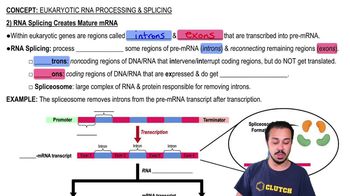
Exons are coding sequences that remain in mature mRNA, while introns are non-coding sequences removed during processing.
What does not occur during the processing of eukaryotic mRNA? A) Addition of a 5' cap B) Addition of a poly-A tail C) Removal of exons D) Removal of introns
C) Removal of exons
What does a spliceosome remove from pre-mRNA during the process of splicing?
A spliceosome removes introns from pre-mRNA during splicing.
What process removes introns from mRNA?
RNA splicing removes introns from mRNA.
What happens to introns in eukaryotic mRNA?
Introns are removed during RNA splicing and do not appear in mature mRNA.
When is the 5' cap added to a pre-mRNA?
The 5' cap is added to pre-mRNA shortly after transcription initiation.
How is a protein domain related to the exons of a gene?
Protein domains are often encoded by specific exons within a gene.
What is found in eukaryotic genes but not in prokaryotic genes?
Introns
What would happen if snRNPs did not recognize the branch point within an intron?
If snRNPs did not recognize the branch point, intron removal would be impaired, affecting mRNA maturation.
What is true of introns?
Introns are non-coding sequences that are removed during RNA splicing.
What are the functions of the 7-methylguanosine cap of eukaryotic mRNAs?
The 7-methylguanosine cap protects mRNA from degradation and aids in ribosome attachment.
Where or when does RNA capping at the 5' end of the transcript take place?
RNA capping at the 5' end occurs shortly after transcription initiation.
What are the main modifications that occur during eukaryotic RNA processing, and what is their purpose?
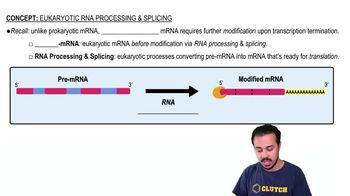
During eukaryotic RNA processing, a 5' cap (a modified guanine nucleotide) is added to the 5' end, and a poly-A tail (a stretch of adenine nucleotides) is added to the 3' end of the pre-mRNA. These modifications enhance mRNA stability, facilitate export from the nucleus, and help ribosomes attach for translation.
What is the function of the spliceosome in eukaryotic cells?
The spliceosome is a large complex of RNA and protein that removes introns from pre-mRNA and splices together the exons to produce mature mRNA.
What is alternative RNA splicing, and how does it affect protein diversity?
Alternative RNA splicing is the process by which a single pre-mRNA can be spliced in different ways to include or exclude certain exons, resulting in multiple protein variants from a single gene and increasing protein diversity.
Why does RNA processing and splicing occur in eukaryotes but not in prokaryotes?
Eukaryotic genes contain introns and exons, requiring processing and splicing to produce mature mRNA, while prokaryotic genes lack introns and their mRNA does not require these modifications.
How do the modifications at the ends of eukaryotic mRNA facilitate its export from the nucleus?
The 5' cap and poly-A tail are recognized by cellular machinery that helps transport the mature mRNA from the nucleus to the cytoplasm, where translation occurs.
 Back
Back
 02:32
02:32