Skip to main content
General Biology
My Course
Learn
Exam Prep
AI Tutor
Study Guides
Textbook Solutions
Flashcards
Explore
Try the app
My Course
Learn
Exam Prep
AI Tutor
Study Guides
Textbook Solutions
Flashcards
Explore
Try the app
Back
Extinctions definitions
You can tap to flip the card.
Extinction
You can tap to flip the card.
👆
Extinction
A process that removes species from the tree of life, shaping biodiversity by ending evolutionary lineages.
Track progress
Control buttons has been changed to "navigation" mode.
1/15
Related flashcards
Related practice
Recommended videos
Extinctions quiz #2
Extinctions
11 Terms
Extinctions quiz #3
Extinctions
10 Terms
Extinctions
24. History of Life on Earth
5 problems
Topic
Adaptive Radiation
24. History of Life on Earth
5 problems
Topic
24. History of Life on Earth - Part 1 of 2
4 topics
10 problems
Chapter
Jason
24. History of Life on Earth - Part 2 of 2
2 topics
5 problems
Chapter
Guided course
04:55
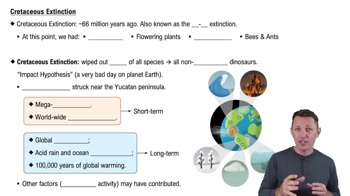
Cretaceous Extinction
2170
views
17
rank
1
comments
Guided course
04:48
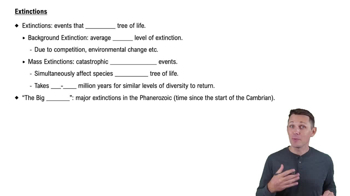
Extinctions
2378
views
23
rank
Guided course
02:29
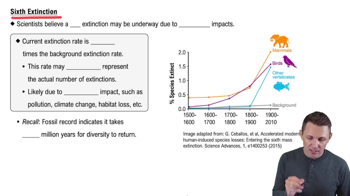
Sixth Extinction
2189
views
16
rank
Terms in this set (15)
Hide definitions
Extinction
A process that removes species from the tree of life, shaping biodiversity by ending evolutionary lineages.
Background Extinction
A low, ongoing rate of species loss caused by competition or environmental changes, not linked to catastrophic events.
Mass Extinction
A rare event where a large percentage of species vanish rapidly due to catastrophic environmental disruptions.
Permian Extinction
A catastrophic event 252 million years ago, erasing 96% of marine and 70% of terrestrial species, mainly from volcanic activity.
Cretaceous Extinction
A global crisis 66 million years ago, marked by a meteorite impact, that ended the reign of non-avian dinosaurs.
Phanerozoic
The geological eon beginning with the Cambrian, characterized by abundant animal fossils and the big five extinctions.
Paleozoic
An era from the Cambrian to the Permian, featuring early animal diversification and ending with a massive extinction.
Mesozoic
The era following the Paleozoic, known as the age of dinosaurs, ending with the Cretaceous extinction.
Cenozoic
The current era, beginning after the Cretaceous extinction, often called the age of mammals.
Pangaea
A supercontinent existing during the Permian, where most terrestrial life was concentrated.
Acid Rain
A phenomenon resulting from volcanic gases or impacts, causing widespread plant death and ecosystem collapse.
Ocean Acidification
A chemical shift in seawater, often following extinctions, making survival difficult for marine organisms.
Background Extinction Rate
The typical pace at which species disappear over time, serving as a baseline for comparing mass extinctions.
Sixth Extinction
A current, human-driven biodiversity crisis with extinction rates far above historical norms.
Fossil Record
The preserved remains and traces of ancient life, crucial for identifying extinction patterns and rates.
 BackBack
 04:55
04:55