Pearson+ LogoPearson+ Logo

Factors Limiting Population Growth quiz #3 Flashcards

Back
Factors Limiting Population Growth quiz #3
Control buttons has been changed to "navigation" mode.
1/19
  • How do density independent factors differ from density dependent factors in their impact on population growth?

    Density independent factors affect population growth regardless of population density. Their impact is constant and not influenced by how many individuals are present. Examples include natural disasters like floods, fires, and temperature extremes.
  • Give three examples of density dependent factors and explain why they are considered density dependent.

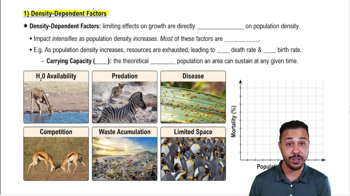
    Examples include competition for resources, disease transmission, and predation. They are considered density dependent because their effects become stronger as population density increases, leading to more competition, higher disease spread, and increased predation.
  • How do density dependent factors help regulate population size in an ecosystem?

    Density dependent factors increase mortality or decrease birth rates as population density rises, preventing populations from exceeding the carrying capacity and helping maintain ecological balance.
  • What is the main difference in how density dependent and density independent factors influence small versus large populations?

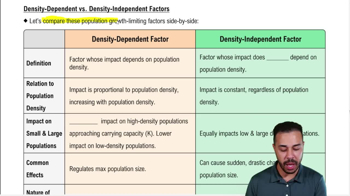
    Density dependent factors have a greater impact on large, high-density populations, while density independent factors affect small and large populations equally.
  • How do density independent factors differ from density dependent factors in their impact on population growth?

    Density independent factors affect population growth equally regardless of population density, while density dependent factors have effects that intensify as population density increases.
  • Give three examples of density dependent factors and explain why they are considered density dependent.

    Examples include competition for resources, disease transmission, and predation; they are considered density dependent because their effects become stronger as population density increases.
  • How do density dependent factors help regulate population size in an ecosystem?

    Density dependent factors increase mortality or decrease birth rates as population density rises, preventing populations from exceeding the carrying capacity and maintaining ecological balance.
  • What is the main difference in how density dependent and density independent factors influence small versus large populations?

    Density dependent factors have a greater impact on large, high-density populations, while density independent factors affect small and large populations equally.
  • What is carrying capacity and how is it related to density dependent factors?

    Carrying capacity is the maximum population size an area can sustain, and density dependent factors help populations approach and not exceed this limit by increasing their impact as density rises.
  • Are density independent factors usually biotic or abiotic, and can you give two examples?

    Density independent factors are usually abiotic, such as floods and temperature extremes.
  • What is the biotic potential of a population?

    The biotic potential of a population is the maximum rate at which a population could increase under ideal conditions, with no limiting factors present.
  • What is a limiting factor that depends on population size called?

    A limiting factor that depends on population size is called a density dependent factor.
  • Give an example of a density dependent limiting factor.

    Examples of density dependent limiting factors include competition, predation, disease, limited resources, waste accumulation, and limited space.
  • How do density-independent population control factors cause mortality?

    Density-independent population control factors cause mortality regardless of population size, often through abiotic events like natural disasters, temperature extremes, or droughts.
  • What determines the carrying capacity in an ecosystem?

    The carrying capacity in an ecosystem is determined by limiting factors such as resource availability, competition, predation, disease, and space, which regulate the maximum sustainable population size.
  • What happens during a population overshoot?

    During a population overshoot, the population temporarily exceeds the carrying capacity of the environment, often leading to resource depletion and a subsequent population crash.
  • What condition can cause a population crash?

    A population crash can be caused by a population overshoot, where the population exceeds the carrying capacity and resources become severely limited.
  • How do limited resources affect a population?

    Limited resources increase competition among individuals, leading to higher mortality rates and lower birth rates, which slows population growth.
  • How can high population density be harmful to a population?

    High population density can intensify density dependent factors such as competition, disease, and resource depletion, increasing mortality and decreasing birth rates.