Back

Flowers quiz #3

Control buttons has been changed to "navigation" mode.
1/17
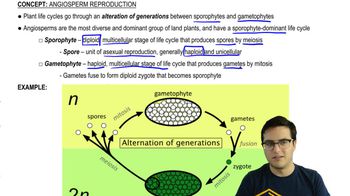
  • How do angiosperms exhibit heterospory, and what are the roles of microspores and megaspores?

    Angiosperms are heterosporous, producing microspores (which develop into male gametophytes or pollen) and megaspores (which develop into female gametophytes or embryo sacs).
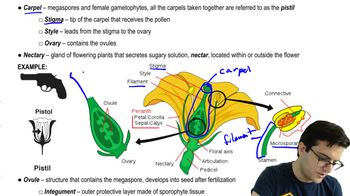
  • What are the main structural components of a typical flower and their functions?

    A typical flower has sepals (protect buds), petals (attract pollinators), stamens (male organs producing pollen), and carpels (female organs containing ovules).
  • Explain the difference between monoecious and dioecious plants.

    Monoecious plants have both male and female flowers on the same individual, while dioecious plants have male and female flowers on separate individuals.
  • How does coevolution influence the relationship between flowers and their pollinators?

    Coevolution leads to mutual adaptations between flowers and pollinators, such as specialized flower structures and pollinator behaviors, enhancing pollination efficiency and food rewards.
  • What is vegetative reproduction in angiosperms, and what are its advantages and disadvantages?

    Vegetative reproduction is asexual reproduction via structures like rhizomes, stolons, or fragmentation, producing genetically identical offspring. It is efficient but reduces genetic diversity, making populations more vulnerable to disease.
  • How do angiosperms exhibit heterospory, and what are the roles of microspores and megaspores?

    Angiosperms are heterosporous, producing microspores that develop into male gametophytes (pollen) and megaspores that develop into female gametophytes (embryo sacs). Microspores give rise to sperm, while megaspores give rise to eggs.
  • What are the main structural components of a typical flower and their functions?

    A typical flower has sepals (protect buds), petals (attract pollinators), stamens (male organs producing pollen), and carpels (female organs containing ovules). Each part plays a role in reproduction or attracting pollinators.
  • Explain the difference between monoecious and dioecious plants.

    Monoecious plants have both male and female flowers on the same individual, while dioecious plants have male and female flowers on separate individuals. This affects how pollination and reproduction occur in these species.
  • How does coevolution influence the relationship between flowers and their pollinators?

    Coevolution leads to mutual adaptations, such as specialized flower structures and pollinator behaviors, that enhance pollination efficiency and food rewards. This results in a close interdependence between specific flowers and their pollinators.
  • What is vegetative reproduction in angiosperms, and what are its advantages and disadvantages?

    Vegetative reproduction is asexual reproduction using structures like rhizomes, stolons, or fragmentation, producing genetically identical offspring. It is efficient but reduces genetic diversity, making populations more vulnerable to disease.
  • What does it mean if a plant is dioecious?

    A dioecious plant has male and female flowers on separate individual plants, meaning each plant produces only male or only female flowers.
  • To which part of the plant does the flower attach?

    The flower attaches to the stem of the plant.
  • What part of the plant is a pumpkin?

    A pumpkin is the fruit of the plant, which develops from the ovary after fertilization.
  • What is the function of the ovary in a flower?

    The ovary is the part of the flower that contains ovules, which develop into seeds after fertilization and also gives rise to the fruit.
  • What is the difference between monoecious and dioecious plants?

    Monoecious plants have both male and female flowers on the same individual, while dioecious plants have male and female flowers on separate individuals.
  • What is the role of sepals in a flower?

    Sepals protect the flower bud before it opens and collectively form the calyx.
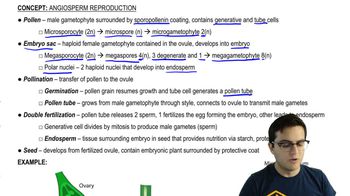
  • What is double fertilization in angiosperms?

    Double fertilization is a process in angiosperms where one sperm fertilizes the egg to form the embryo, and another sperm fuses with polar nuclei to form the nutrient-rich endosperm.