Back

Genetic Drift definitions

Control buttons has been changed to "navigation" mode.
1/15
  • Genetic Drift

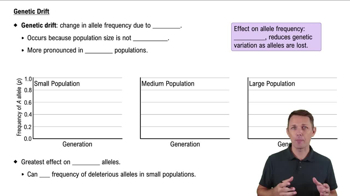
    Random fluctuation in allele frequencies, especially impactful in small populations, leading to unpredictable genetic outcomes.
  • Allele Frequency

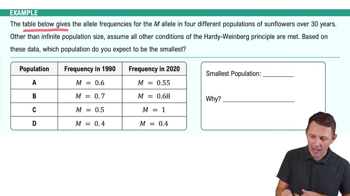
    Proportion of a specific genetic variant within a population, subject to change by chance events.
  • Population Size

    Number of individuals in a group, influencing the magnitude of random genetic changes.
  • Founder Effect

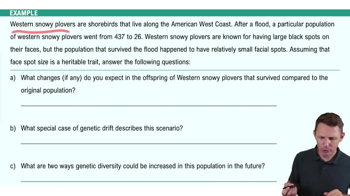
    Genetic pattern arising when a new group is established by a few individuals, reflecting only their genetic makeup.
  • Population Bottleneck

    Sharp reduction in group size due to environmental events, causing rapid genetic shifts among survivors.
  • Fixation

    State where only one genetic variant remains in a population, eliminating all alternatives.
  • Genetic Variation

    Diversity of genetic traits within a group, which can diminish through random allele loss.
  • Neutral Allele

    Genetic variant with no effect on survival or reproduction, mainly influenced by random changes.
  • Deleterious Allele

    Genetic variant that reduces fitness, yet may increase in frequency due to random effects in small groups.
  • Beneficial Allele

    Genetic variant that enhances fitness, but can still decrease in frequency by chance in small populations.
  • Hardy-Weinberg

    Mathematical principle predicting genetic makeup under ideal conditions, serving as a baseline for comparison.
  • Fitness

    Likelihood that a genetic variant contributes to survival or reproduction, influencing evolutionary outcomes.
  • Random Change

    Unpredictable alteration in genetic composition, not driven by selection or adaptation.
  • Generation Time

    Interval between successive generations, over which genetic shifts can accumulate.
  • Probability

    Measure of likelihood for genetic events, underlying the unpredictability of allele frequency changes.