 Back
BackIntroduction to Biomolecules exam

 01:17
01:17
Terms in this set (30)
Biomolecules
Molecules found in living organisms and essential for life.
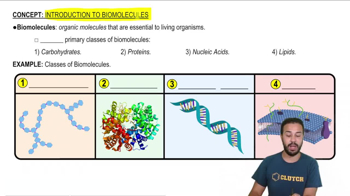
What are the four primary classes of biomolecules?
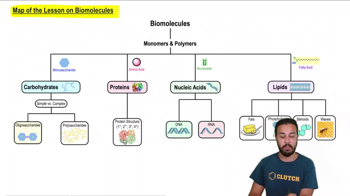
Carbohydrates, proteins, nucleic acids, and lipids.
Monomers
Building blocks of biomolecules, such as monosaccharides, amino acids, nucleotides, and fatty acids.
Carbohydrates
Biomolecules that provide energy.
Proteins
Biomolecules that support structure and function.
Nucleic Acids
Biomolecules that store genetic information.
Lipids
Biomolecules involved in energy storage and cellular membranes.
What is the function of carbohydrates?
To provide energy.
What is the function of proteins?
To support structure and function.
What is the function of nucleic acids?
To store genetic information.
What is the function of lipids?
Energy storage and forming cellular membranes.
Monosaccharides
Simple sugar monomers of carbohydrates.
Amino Acids
Monomers of proteins.
Nucleotides
Monomers of nucleic acids.
Fatty Acids
Monomers of lipids.
What are the monomers of carbohydrates?
Monosaccharides.
What are the monomers of proteins?
Amino acids.
What are the monomers of nucleic acids?
Nucleotides.
What are the monomers of lipids?
Fatty acids.
Simple Carbohydrates
Carbohydrates consisting of one or two sugar molecules.
Complex Carbohydrates
Carbohydrates consisting of long chains of sugar molecules.
Oligosaccharides
Carbohydrates composed of 3-10 monosaccharides.
Polysaccharides
Carbohydrates composed of more than 10 monosaccharides.
What are simple carbohydrates?
Carbohydrates with one or two sugar molecules.
What are complex carbohydrates?
Carbohydrates with long chains of sugar molecules.
What are oligosaccharides?
Carbohydrates with 2-10 monosaccharides.
What are polysaccharides?
Carbohydrates with more than 10 monosaccharides.
Phospholipids
A type of lipid that forms cellular membranes.
Steroids
A type of lipid involved in signaling and structural functions.
Waxes
A type of lipid that provides protective coatings.