What are the two key components required for cell signaling?
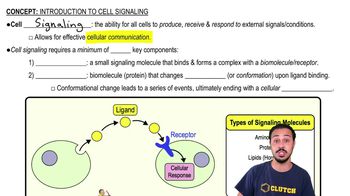
The two key components required for cell signaling are the ligand (signaling molecule) and the receptor (typically a protein that binds the ligand).
What is a receptor in cell signaling?
A receptor is a biomolecule, usually a protein, that binds to a ligand and undergoes a conformational change to transmit the signal inside the cell.
What are the three main steps of cell signaling?
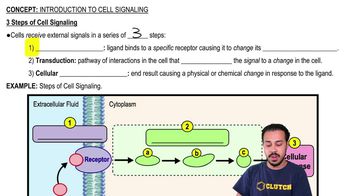
The three main steps of cell signaling are reception (ligand binding), transduction (signal conversion through molecular interactions), and cellular response (a physical or chemical change in the cell).
What occurs during the reception step of cell signaling?
During reception, the ligand binds to a specific receptor on the target cell, causing the receptor to change its shape.
What is signal transduction in cell signaling?
Signal transduction is the process by which the signal from the ligand-receptor interaction is converted and relayed through a series of molecular interactions inside the cell.
What is the cellular response in cell signaling?
The cellular response is the final step in cell signaling, resulting in a physical or chemical change within the target cell in response to the original signal.
What types of molecules can act as ligands in cell signaling?
Ligands can include amino acids, proteins, lipids, hormones, nucleotides, dissolved gases, and neurotransmitters.
What is the role of the signaling cell in cell signaling?
The signaling cell produces and releases the ligand that initiates the signaling process.
What is the target cell in cell signaling?
The target cell is the cell that contains the receptor for the ligand and responds to the signal.
How does the conformational change in a receptor affect the cell?
The conformational change in the receptor triggers a cascade of intracellular events that lead to the cell's response.
Why is specificity important in ligand-receptor interactions?
Specificity ensures that only the correct ligand binds to its corresponding receptor, leading to the appropriate cellular response.
Can cell signaling occur between distant cells?
Yes, cell signaling can occur between both neighboring and distant cells, allowing for widespread communication in multicellular organisms.
What is meant by a conformational change in a receptor?
A conformational change refers to a structural alteration in the receptor protein upon ligand binding, which is essential for signal transduction.
How does the process of transduction vary between different signaling pathways?
The transduction process can involve different molecules and steps, depending on the specific signaling pathway, but always serves to relay and amplify the signal inside the cell.
What is the ultimate outcome of cell signaling?
The ultimate outcome of cell signaling is a specific cellular response, such as a change in gene expression, metabolism, or cell behavior.
Why are receptors typically proteins?
Receptors are typically proteins because proteins can form specific binding sites for ligands and undergo conformational changes necessary for signal transduction.
What is the significance of the plasma membrane in cell signaling?
The plasma membrane often contains embedded receptors that detect extracellular ligands and initiate the signaling process.
How do signaling molecules reach their target cells?
Signaling molecules can diffuse through extracellular fluid to reach and bind to receptors on target cells.
What is the difference between a signaling cell and a target cell?
A signaling cell produces and releases the ligand, while a target cell possesses the receptor and responds to the ligand.
What is the function of neurotransmitters in cell signaling?
Neurotransmitters act as ligands that transmit signals between nerve cells or from nerve cells to other target cells.
How do hormones function as ligands in cell signaling?
Hormones are signaling molecules that travel through the bloodstream to distant target cells, where they bind to specific receptors and elicit responses.
What is meant by the term 'signal transduction pathway'?
A signal transduction pathway is the series of molecular events triggered by ligand-receptor binding that leads to a cellular response.
Why is cell signaling considered essential for multicellular organisms?
Cell signaling is essential for coordinating activities, development, and responses among the many cells in multicellular organisms.
What is the role of dissolved gases as ligands in cell signaling?
Dissolved gases, such as nitric oxide, can act as ligands that diffuse across membranes and bind to intracellular receptors to trigger responses.
How does ligand binding initiate a signal inside the cell?
Ligand binding causes the receptor to change shape, which activates intracellular signaling molecules and initiates the transduction process.
What is the importance of the specificity of ligand-receptor binding?
Specificity ensures that only the correct signals are received and responded to, preventing inappropriate cellular responses.
How can proteins act as ligands in cell signaling?
Proteins can serve as ligands by binding to specific receptors on target cells to initiate signaling pathways.
What is the first step in the cell signaling process?
The first step is reception, where the ligand binds to its specific receptor.
What is the second step in the cell signaling process?
The second step is transduction, where the signal is relayed and converted through a series of molecular interactions.
What is the third step in the cell signaling process?
The third step is the cellular response, where the cell undergoes a physical or chemical change in response to the signal.
How do amino acids function as ligands in cell signaling?
Amino acids can act as signaling molecules by binding to specific receptors and triggering cellular responses.
What is the role of nucleotides as ligands in cell signaling?
Nucleotides can serve as signaling molecules that bind to receptors and initiate signal transduction pathways.
Why is the conformational change of a receptor important in cell signaling?
The conformational change activates the receptor, allowing it to interact with other intracellular molecules and propagate the signal.
What is meant by a 'series of molecular interactions' in signal transduction?
It refers to the sequential activation of intracellular molecules that relay and amplify the signal from the receptor to the cellular response.
How does cell signaling contribute to cellular communication?
Cell signaling enables cells to detect and respond to signals from their environment or other cells, facilitating coordinated actions.
What is the function of lipids as ligands in cell signaling?
Lipids can act as signaling molecules by binding to specific receptors and initiating cellular responses.
How does the binding of a ligand to a receptor lead to a cellular response?
Ligand binding triggers a conformational change in the receptor, which activates a signaling cascade that results in a cellular response.
What is the significance of the target cell in cell signaling?
The target cell is the recipient of the signal and is responsible for executing the appropriate response to the ligand.
How do signaling pathways differ from one another?
Signaling pathways can differ in the types of ligands, receptors, and intracellular molecules involved, as well as the specific cellular responses they produce.
What is the main purpose of the transduction step in cell signaling?
The main purpose of transduction is to relay and amplify the signal from the receptor to the appropriate cellular machinery for a response.
 Back
Back
 05:03
05:03