How do cells ensure that only specific signals are received and acted upon?
Cells express specific receptors that only bind to particular ligands, ensuring selective and appropriate responses.
What is the role of the extracellular fluid in cell signaling?
The extracellular fluid serves as the medium through which ligands travel to reach target cells and their receptors.
How does a signaling molecule produced by one cell affect another cell?
The signaling molecule (ligand) diffuses to the target cell, binds to its receptor, and triggers a response in that cell.
What is the importance of cell signaling in maintaining homeostasis?
Cell signaling allows cells to respond to changes in their environment, helping maintain stable internal conditions (homeostasis).
How do neurotransmitters differ from hormones as ligands?
Neurotransmitters typically act over short distances between nerve cells, while hormones can travel long distances through the bloodstream to reach target cells.
What is meant by a 'cellular response' in the context of cell signaling?
A cellular response is the specific change in cell activity or function that occurs as a result of a signaling pathway being activated.
Why is it important for receptors to be embedded in the cell membrane?
Membrane-embedded receptors can detect extracellular ligands and initiate signaling pathways inside the cell.
How does the process of cell signaling begin?
Cell signaling begins when a ligand is produced by a signaling cell and released into the extracellular environment.
What is the function of the signaling cell in the cell signaling process?
The signaling cell synthesizes and releases the ligand that initiates communication with the target cell.
How do cells distinguish between different types of ligands?
Cells have specific receptors that recognize and bind only to certain ligands, allowing them to distinguish between different signals.
What is the role of the cytoplasm in cell signaling?
The cytoplasm contains the intracellular molecules involved in the transduction and response steps of cell signaling.
How does the binding of a ligand to a receptor lead to signal amplification?
The binding event can activate multiple intracellular molecules, amplifying the original signal and producing a larger cellular response.
Why is cell signaling considered a complex process?
Cell signaling is complex due to the variety of ligands, receptors, and intracellular pathways involved, as well as the diversity of possible cellular responses.
What is the significance of the conformational change in the receptor during cell signaling?
The conformational change is crucial for activating the receptor and initiating the intracellular signaling cascade.
How do cells respond to external signals?
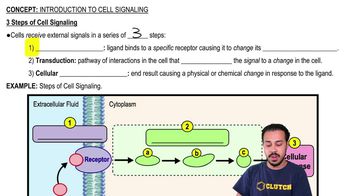
Cells respond to external signals by binding ligands to receptors, transducing the signal, and producing a specific cellular response.
What is the importance of cell signaling in multicellular organisms?
Cell signaling is vital for coordinating growth, development, and responses to environmental changes in multicellular organisms.
How do hormones reach their target cells in cell signaling?
Hormones are released into the bloodstream and travel to distant target cells, where they bind to specific receptors.
What is the function of the plasma membrane in the context of cell signaling?
The plasma membrane houses receptors that detect extracellular ligands and initiate signaling pathways inside the cell.
How does the specificity of ligand-receptor binding contribute to cellular communication?
Specific binding ensures that only the intended signals are received and acted upon, allowing precise communication between cells.
What is the role of amino acids as signaling molecules?
Amino acids can serve as ligands that bind to receptors and initiate specific signaling pathways.
How do cells amplify signals received from ligands?
Cells amplify signals through cascades of molecular interactions, where one activated molecule can activate many others, increasing the response.
What is the relationship between a ligand and its receptor?
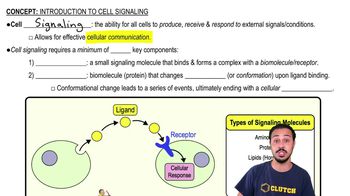
A ligand specifically binds to its receptor, causing the receptor to change shape and initiate a signaling pathway.
How do nucleotides function in cell signaling?
Nucleotides can act as ligands or as secondary messengers within the cell to propagate the signal.
What is the main function of the transduction step in cell signaling?
The main function of transduction is to relay and convert the signal from the receptor to the appropriate cellular machinery for a response.
How do cells ensure that only the correct response is triggered by a signal?
Cells use specific receptors and signaling pathways to ensure that only the appropriate response is triggered by a given ligand.
What is the significance of the cellular response in cell signaling?
The cellular response is the final outcome of the signaling process, resulting in a change in cell activity or function.
How do lipids act as signaling molecules?
Lipids can serve as ligands that bind to specific receptors and initiate signaling pathways leading to cellular responses.
What is the importance of the extracellular environment in cell signaling?
The extracellular environment provides the medium for ligands to travel and interact with receptors on target cells.
How does the process of transduction contribute to the specificity of cell signaling?
Transduction involves specific molecular interactions that ensure the signal is relayed accurately to produce the correct response.
What is the role of proteins as ligands in cell signaling?
Proteins can act as ligands by binding to receptors and initiating specific signaling pathways in target cells.
How do dissolved gases function as ligands in cell signaling?
Dissolved gases, such as nitric oxide, can diffuse across membranes and bind to intracellular receptors to trigger cellular responses.
What is the function of the receptor in the cell signaling process?
The receptor binds to the ligand and undergoes a conformational change to initiate the intracellular signaling cascade.
How does the binding of a ligand to a receptor initiate the transduction step?
Ligand binding causes the receptor to change shape, which activates intracellular signaling molecules and starts the transduction process.
What is the importance of the signaling cell in cell signaling?
The signaling cell produces and releases the ligand that initiates communication with the target cell.
How do cells communicate with each other through cell signaling?
Cells communicate by releasing ligands that bind to receptors on target cells, triggering specific responses.
What is the role of the plasma membrane in the reception step of cell signaling?
The plasma membrane contains receptors that bind extracellular ligands during the reception step.
How does the conformational change in a receptor lead to signal transduction?
The conformational change activates the receptor, allowing it to interact with and activate intracellular signaling molecules.
What is the function of neurotransmitters in the nervous system?
Neurotransmitters transmit signals between nerve cells or from nerve cells to other target cells by acting as ligands.
How do hormones differ from other types of ligands in cell signaling?
Hormones are signaling molecules that travel long distances through the bloodstream to reach distant target cells.
What is the significance of the three-step process in cell signaling?
The three-step process ensures that signals are received, relayed, and responded to accurately and efficiently.
 Back
Back
 05:03
05:03