What are the four main types of species interactions studied in community ecology?
The four main types of species interactions are competition, exploitation (including predation, herbivory, and parasitism), mutualism, and commensalism.
What is the significance of trophic structure in community ecology?
Trophic structure describes the feeding relationships and energy flow among species in a community, which helps determine the community's organization and stability.
What does the term 'community' refer to in community ecology?
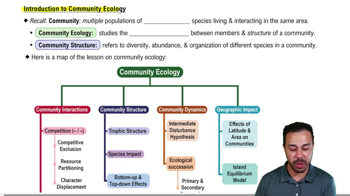
A community refers to multiple populations of different species living and interacting in the same area.
What aspects does community ecology study besides species interactions?
Community ecology also studies the overall structure of the community, including diversity, abundance, and organization of species.
What are the four main types of species interactions in community ecology?
The four main types are competition, exploitation, mutualism, and commensalism.
What are the three types of exploitation interactions discussed in community ecology?
The three types of exploitation are predation, herbivory, and parasitism.
What does trophic structure describe in a community?
Trophic structure describes the feeding relationships and energy flow among species in a community.
What is the significance of trophic structure in community ecology?
Trophic structure helps determine the community's organization and stability.
What are two key concepts discussed under community dynamics in community ecology?
Two key concepts are the intermediate disturbance hypothesis and ecological succession.
Which geographic factors are mentioned as influencing community composition?
Latitude and area are geographic factors that influence community composition.
How does a population differ from a community in ecological terms?
A population consists of individuals of the same species living in a specific area, while a community is made up of multiple populations of different species living and interacting in the same area.
What is the main distinction between a population and a community in ecology?
A population refers to members of a single species in an area, whereas a community includes all the populations of different species that coexist and interact within that area.
Explain the difference between a population and a community in the context of community ecology.
A population is a group of individuals of one species in a given area, while a community encompasses all populations of various species that live and interact together in the same area.
In ecological studies, what sets a population apart from a community?
A population is defined by individuals of one species in a location, but a community includes multiple populations of different species interacting within the same environment.
 Back
Back
 02:03
02:03