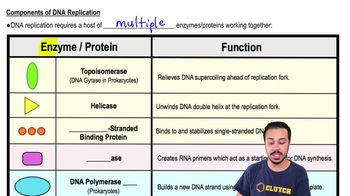
Why is DNA replication said to be “semi-conservative”?
DNA replication is said to be semi-conservative because each new DNA molecule consists of one original strand and one newly synthesized strand.
What does DNA ligase do?
DNA ligase joins Okazaki fragments on the lagging strand by forming covalent bonds between DNA segments.
Which enzyme breaks the hydrogen bonds during replication?
Helicase breaks the hydrogen bonds between the DNA strands during replication.
During which phase of the cell cycle does DNA synthesis occur?
DNA synthesis occurs during the S phase.
Which statement best describes strand characteristics as it relates to DNA replication?
During DNA replication, each new DNA molecule consists of one original strand and one newly synthesized strand.
Which of these is not required for DNA replication? A) DNA polymerase B) RNA primer C) Helicase D) Ribosome
D) Ribosome
Which component is required for DNA replication?
DNA polymerase
What rule is used to join the free nucleotides to the exposed bases of the DNA?
The complementary base pairing rule is used, where adenine pairs with thymine and cytosine pairs with guanine.
Once the chromosome is duplicated, what happens next?
Once the chromosome is duplicated, the cell can proceed to mitosis or meiosis, where the chromosomes are segregated into daughter cells.
Why is DNA replication considered semiconservative?
DNA replication is considered semiconservative because each new DNA molecule contains one original strand and one newly synthesized strand.
During what phase of the cell cycle is DNA replicated?
DNA is replicated during the S phase of the cell cycle.
By which model does DNA replicate?
Semiconservative
How is DNA copied?
DNA is copied through a process called replication, where the double helix is unwound and each strand serves as a template for the synthesis of a new complementary strand.
What are some basic differences in prokaryotic and eukaryotic replication?
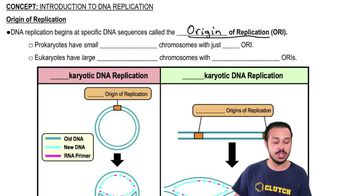
Prokaryotic replication occurs in the cytoplasm with a single origin of replication, while eukaryotic replication occurs in the nucleus with multiple origins of replication.
What is the function of helicase in DNA replication?
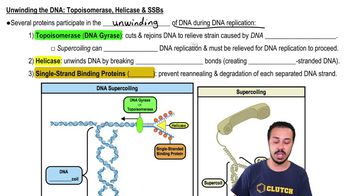
Helicase unwinds the DNA double helix by breaking hydrogen bonds between the base pairs.
Where does DNA replication take place?
DNA replication takes place in the nucleus of eukaryotic cells and in the cytoplasm of prokaryotic cells.
What is meant by semiconservative replication of DNA?
Semiconservative replication means that each new DNA molecule consists of one original strand and one newly synthesized strand.
What are the major enzymes of DNA replication?
The major enzymes of DNA replication include helicase, DNA polymerase, primase, and DNA ligase.
During DNA replication, what role do single-strand binding proteins play?
Single-strand binding proteins stabilize the unwound DNA strands and prevent them from re-annealing.
Which description of DNA replication is correct?
DNA replication is a semi-conservative process where each new DNA molecule consists of one original strand and one newly synthesized strand.
How do you think a DNA molecule makes a copy of itself?
A DNA molecule makes a copy of itself through replication, where the double helix is unwound and each strand serves as a template for a new complementary strand.
What is part of the elongation step of DNA synthesis?
Addition of nucleotides
Is DNA replication in prokaryotes bidirectional?
It is bidirectional.
How is DNA replicated?
DNA is replicated through a semi-conservative process where each original strand serves as a template for a new complementary strand.
Which origins of replication are more sequence-specific?
Prokaryotic origins of replication are more sequence-specific compared to eukaryotic origins.
What is the mechanism of DNA replication?
DNA replication is semiconservative.
What must happen first for DNA replication to occur?
DNA unwinding
Where does DNA replication occur in eukaryotes?
DNA replication does not occur in the cytoplasm of eukaryotes.
What does it mean that DNA replication is semi-conservative?
It means that each new DNA molecule consists of one original strand and one newly synthesized strand.
What enzyme unzips the DNA? What type of bonds does this enzyme have to break?
Helicase unzips the DNA by breaking hydrogen bonds between the base pairs.
After the DNA duplicates, what is the next step in the cell cycle?
After DNA duplication, the cell enters mitosis or meiosis, where the duplicated chromosomes are segregated into daughter cells.
What is the first step in eukaryotic DNA replication?
The first step is the unwinding of the DNA double helix at multiple origins of replication.
In DNA recombination, what occurs?
In DNA recombination, genetic material is exchanged between different DNA molecules, leading to genetic diversity.
After the DNA duplicated, what happens to the cell?
After DNA duplication, the cell prepares for division, either through mitosis or meiosis.
Which of these are involved in the unwinding of DNA during replication? A) Helicase B) DNA polymerase C) Primase D) Ribosome
A) Helicase
Why does DNA form multiple origins of replication along the chromosome?
Multiple origins of replication allow for faster and more efficient replication of large eukaryotic genomes.
What is the role of helicase in DNA replication?
Helicase unwinds the DNA double helix by breaking hydrogen bonds between the base pairs.
Does DNA replication occur in the cytoplasm of eukaryotes?
 Back
Back

 05:10
05:10