Skip to main content
General Biology
My Course
Learn
Exam Prep
AI Tutor
Study Guides
Textbook Solutions
Flashcards
Explore
Try the app
My Course
Learn
Exam Prep
AI Tutor
Study Guides
Textbook Solutions
Flashcards
Explore
Try the app
Back
Introduction to Metabolism exam
You can tap to flip the card.
Metabolism
You can tap to flip the card.
👆
Metabolism
All chemical reactions within an organism.
Track progress
Control buttons has been changed to "navigation" mode.
1/28
Related flashcards
Related practice
Recommended videos
Introduction to Metabolism definitions
Introduction to Metabolism
6 Terms
Introduction to Metabolism quiz #1
Introduction to Metabolism
17 Terms
Introduction to Metabolism quiz #2
Introduction to Metabolism
33 Terms
Introduction to Metabolism
7. Energy and Metabolism
4 problems
Topic
Jason
Negative & Positive Feedback
7. Energy and Metabolism
4 problems
Topic
KeyshawnDavis
7. Energy and Metabolism
10 topics
13 problems
Chapter
Brendan
02:17
Introduction to Metabolism
21082
views
392
rank
03:25
Catabolic & Anabolic Pathways
19576
views
339
rank
2
comments
Terms in this set (28)
Hide definitions
Metabolism
All chemical reactions within an organism.
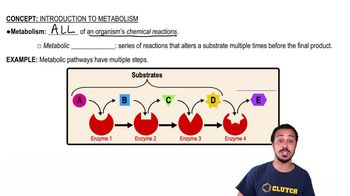
What are metabolic pathways?
A series of chemical reactions that alter a substrate through multiple steps to produce a final product.
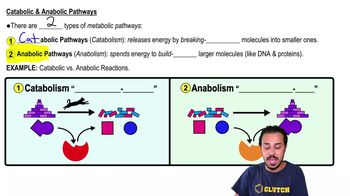
Catabolic Pathways
Pathways that release energy by breaking down molecules into smaller ones.
Anabolic Pathways
Pathways that require energy to synthesize larger molecules from smaller ones.
What is catabolism associated with?
Exergonic processes.
What is anabolism associated with?
Endergonic processes.
Substrate
The initial molecule that undergoes changes in a metabolic pathway.
What is the role of enzymes in metabolic pathways?
Enzymes catalyze each step in the pathway, converting substrates into products.
Exergonic Process
A process that releases energy.
Endergonic Process
A process that requires an input of energy.
What happens in a catabolic pathway?
Large molecules are broken down into smaller components, releasing energy.
What happens in an anabolic pathway?
Smaller molecules are built up into larger molecules, requiring energy.
Final Product
The end molecule produced in a metabolic pathway.
How can you remember catabolism?
Think of a cat breaking down a pyramid into smaller pieces.
How can you remember anabolism?
Think of building up larger structures from smaller building blocks.
What is the main difference between catabolism and anabolism?
Catabolism breaks down molecules, while anabolism builds up molecules.
Energy Release
Characteristic of catabolic pathways.
Energy Requirement
Characteristic of anabolic pathways.
What is the significance of metabolic pathways?
They help organisms manage energy and build cellular structures.
Enzyme
A protein that catalyzes chemical reactions in metabolic pathways.
What is an example of an anabolic process?
Synthesis of DNA and proteins.
What is an example of a catabolic process?
Breaking down glucose during cellular respiration.
What does a metabolic pathway consist of?
Multiple enzymatic steps that convert substrates into final products.
What is the role of energy in metabolism?
Energy is either released (catabolism) or required (anabolism) in metabolic pathways.
What is the final product in a metabolic pathway?
The molecule produced after all enzymatic steps are completed.
What is the relationship between catabolism and exergonic processes?
Catabolism involves exergonic processes that release energy.
What is the relationship between anabolism and endergonic processes?
Anabolism involves endergonic processes that require energy.
What is the purpose of metabolic pathways?
To transform substrates through a series of enzymatic steps to manage energy and build cellular structures.
 BackBack


 02:17
02:17