Skip to main content
General Biology
My Course
Learn
Exam Prep
AI Tutor
Study Guides
Textbook Solutions
Flashcards
Explore
Try the app
My Course
Learn
Exam Prep
AI Tutor
Study Guides
Textbook Solutions
Flashcards
Explore
Try the app
Back
Introduction to the Cell Cycle exam
You can tap to flip the card.
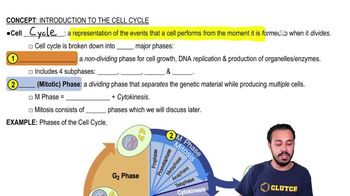
Cell Cycle
You can tap to flip the card.
👆
Cell Cycle
The series of events that a cell goes through from its formation to its division into two daughter cells.
Track progress
Control buttons has been changed to "navigation" mode.
1/28
Related flashcards
Related practice
Recommended videos
Introduction to the Cell Cycle definitions
Introduction to the Cell Cycle
9 Terms
Introduction to the Cell Cycle quiz #1
Introduction to the Cell Cycle
14 Terms
Introduction to the Cell Cycle quiz #2
Introduction to the Cell Cycle
40 Terms
Introduction to the Cell Cycle
11. Cell Division
4 problems
Topic
Jason
Interphase
11. Cell Division
4 problems
Topic
Jason
11. Cell Division - Part 1 of 2
5 topics
9 problems
Chapter
Jason
11. Cell Division - Part 2 of 2
4 topics
9 problems
Chapter
Jason
04:46
Introduction to the Cell Cycle
20595
views
331
rank
1
comments
Terms in this set (28)
Hide definitions
Cell Cycle
The series of events that a cell goes through from its formation to its division into two daughter cells.
Interphase
A non-dividing phase of the cell cycle where the cell grows, replicates DNA, and produces organelles.
What are the two major phases of the cell cycle?
Interphase and the Mitotic Phase (M phase).
G0 Phase
A subphase of interphase where the cell is in a quiescent state and not actively preparing to divide.
What happens during the G1 phase?
The cell grows and synthesizes proteins and organelles.
S Phase
The phase of interphase where DNA replication occurs.
What is the G2 phase?
The final subphase of interphase where the cell prepares for mitosis by producing proteins and organelles.
M Phase
The phase of the cell cycle that includes mitosis and cytokinesis, leading to cell division.
What are the subphases of mitosis?
Prophase, Prometaphase, Metaphase, Anaphase, and Telophase.
Prophase
The first subphase of mitosis where chromatin condenses into visible chromosomes.
What occurs during prometaphase?
The nuclear envelope breaks down and spindle fibers attach to kinetochores.
Metaphase
The subphase of mitosis where chromosomes align at the cell's equatorial plate.
What happens during anaphase?
Sister chromatids are pulled apart to opposite poles of the cell.
Telophase
The final subphase of mitosis where chromosomes decondense and nuclear envelopes reform.
Cytokinesis
The process that divides the cytoplasm of a parental cell into two daughter cells.
What is the main purpose of the cell cycle?
To ensure that cells grow, replicate their DNA, and divide properly to produce two daughter cells.
What is the significance of the G0 phase?
It allows cells to exit the cell cycle and enter a state of dormancy or differentiation.
How is interphase different from the M phase?
Interphase is a non-dividing phase focused on growth and preparation, while the M phase involves actual cell division.
What is the role of mitosis in the cell cycle?
To ensure accurate separation of genetic material into two daughter cells.
Why is DNA replication important in the S phase?
It ensures that each daughter cell receives an identical set of chromosomes.
What are the key activities in the G2 phase?
Cell growth, production of proteins, and preparation for mitosis.
What marks the end of the M phase?
The completion of cytokinesis, resulting in two separate daughter cells.
Why is the cell cycle important in biology?
It is essential for growth, development, and tissue repair in multicellular organisms.
What is the relationship between mitosis and cytokinesis?
Mitosis divides the nucleus, while cytokinesis divides the cytoplasm, completing cell division.
What happens to the nuclear envelope during prometaphase?
It breaks down, allowing spindle fibers to interact with chromosomes.
How do cells ensure proper chromosome alignment during metaphase?
Spindle fibers attach to kinetochores and align chromosomes at the metaphase plate.
What is the significance of anaphase in mitosis?
It ensures that each daughter cell receives an identical set of chromosomes by separating sister chromatids.
What changes occur in telophase?
Chromosomes decondense, and nuclear envelopes reform around the separated sets of chromosomes.
 BackBack
 04:46
04:46