Skip to main content
General Biology
My Course
Learn
Exam Prep
AI Tutor
Study Guides
Textbook Solutions
Flashcards
Explore
Try the app
My Course
Learn
Exam Prep
AI Tutor
Study Guides
Textbook Solutions
Flashcards
Explore
Try the app
Back
Life's Organizational Hierarchy exam
2 students found this helpful
You can tap to flip the card.
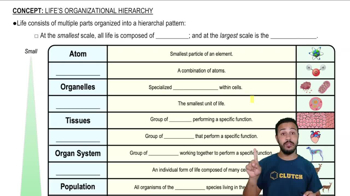
Atom
You can tap to flip the card.
👆
Atom
The smallest particle of an element that retains its chemical properties.
Track progress
Control buttons has been changed to "navigation" mode.
1/29
Related flashcards
Related practice
Recommended videos
Life's Organizational Hierarchy definitions
Life's Organizational Hierarchy
19 Terms
Life's Organizational Hierarchy quiz #1
Life's Organizational Hierarchy
18 Terms
Life's Organizational Hierarchy quiz #2
Life's Organizational Hierarchy
22 Terms
Life's Organizational Hierarchy
1. Introduction to Biology
4 problems
Topic
Jason
Natural Selection and Evolution
1. Introduction to Biology
7 problems
Topic
Jason
1. Introduction to Biology
6 topics
8 problems
Chapter
Jason
09:50
Life's Organizational Hierarchy
28507
views
676
rank
10
comments
04:05
Emergent Properties
18530
views
449
rank
1
comments
03:05
Life's Organizational Hierarchy Example 1
16557
views
462
rank
1
comments
Terms in this set (29)
Hide definitions
Atom
The smallest particle of an element that retains its chemical properties.
What is a molecule?
A combination of two or more atoms joined together.
Organelle
Specialized structures within a cell that perform specific functions.
What is the smallest unit of life?
The cell.
Tissue
A group of the same type of cells that perform a specific function.
What is an organ?
A group of tissues that work together to perform a specific function.
Organ System
A group of organs that work together to perform a specific function.
What is a multicellular organism?
An individual form of life composed of many cells.
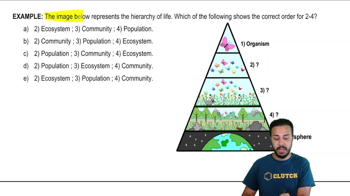
Population
All the organisms of the same species living together in the same area.
What is a community?
Multiple populations of different species living together in the same area.
Ecosystem
A community of living organisms and their nonliving environment.
What is the biosphere?
All the ecosystems on Earth that support life.
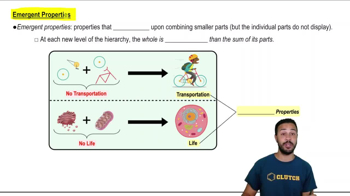
Emergent Properties
Properties that arise when smaller parts combine to form a more complex whole.
What is an example of an emergent property?
Life is an emergent property that arises when organelles combine to form a cell.
What is the role of atoms in the hierarchy of life?
Atoms are the smallest units that make up both living and nonliving matter.
How do molecules relate to organelles?
Molecules combine in specific ways to form organelles.
What is the relationship between tissues and organs?
Multiple tissues combine to form an organ.
How do organ systems contribute to multicellular organisms?
Organ systems work together to support the functions of multicellular organisms.
What distinguishes a population from a community?
A population consists of the same species, while a community includes multiple species.
How does an ecosystem differ from a community?
An ecosystem includes both living communities and their nonliving environment.
What is the significance of the biosphere in the hierarchy of life?
The biosphere encompasses all ecosystems that support life on Earth.
How do emergent properties relate to the hierarchy of life?
Emergent properties arise at each new level of the hierarchy, making the whole greater than the sum of its parts.
What is an example of an organ system?
The cardiovascular system, which includes the heart and blood vessels.
How do cells form tissues?
Multiple cells of the same type group together to form tissues.
What is the role of organelles in cells?
Organelles perform specific functions necessary for the cell's survival and operation.
How do populations form communities?
Multiple populations of different species living together form a community.
What is the smallest scale in the hierarchy of life?
The atom.
How do ecosystems contribute to the biosphere?
Ecosystems collectively make up the biosphere, supporting life on Earth.
What is the importance of understanding life's organizational hierarchy?
It helps in grasping biological organization and interactions.
 BackBack
 09:50
09:50